One in four elementary school students (26 percent) has a history of nicotine initiation, with an e-cigarette being the first nicotine product in their lives for 7 in 10 (73.3 percent). More than half (53.8 percent) of the students have tried nicotine products due to curiosity about their taste. Among students currently using nicotine, the largest number (8 in 10), use e-cigarettes, most often with sweet, fruity or dessert flavors. These are the alarming results of the latest survey of schoolchildren, conducted by CBOS on a group of 1,380 students, mostly 13- and 14-year-olds. The authors of the report are experts gathered around the Polish Society for the Advancement of Medicine - MEDICINE XXI.
One in four elementary school students has already tried nicotine. For 7 in 10 teens, e-cigarettes were the gateway to addiction

Published Oct. 14, 2024 15:02

Fot. iStock/Getty Images
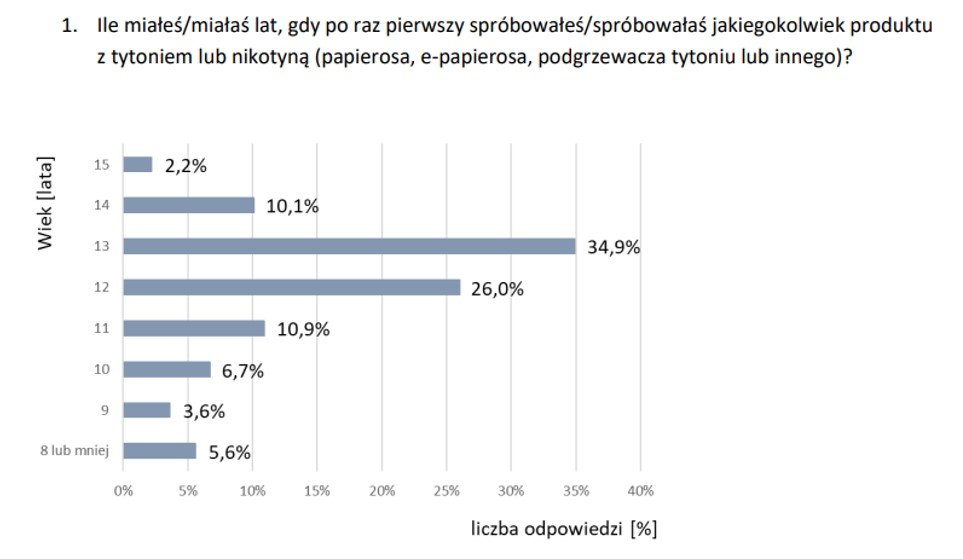
The age of nicotine initiation is dropping alarmingly. One in three students (34.9 percent) say they had their first exposure to nicotine when they were just 13 years old. One in four (26 percent) were 12 years old, and one in ten (10.9 percent) were 11 years old. Nicotine initiation affects even 8-year-olds, among whom 5.6 percent of students have already tried a nicotine-containing product.
E-cigarettes a gateway to nicotine addiction among students
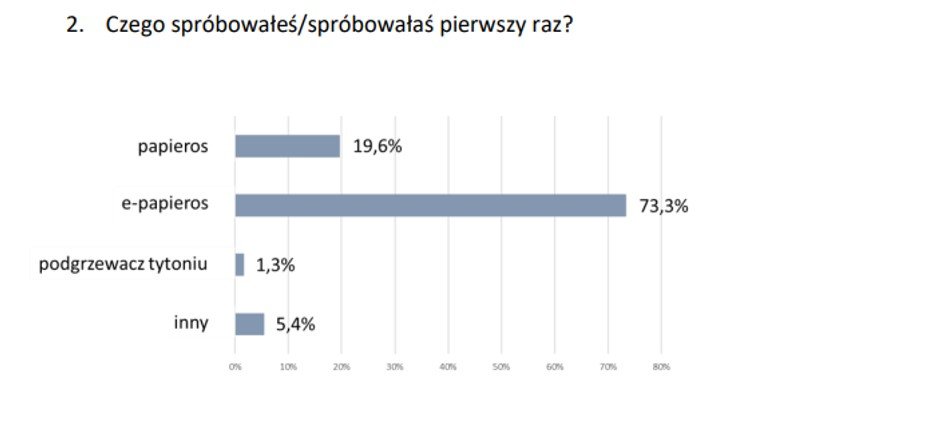
For minors, e-cigarettes are the main gateway to nicotine addiction: as many as 73.3 percent of students identified them as the first nicotine product in their lives.
So-called "vape" (e-cigarettes), popular among young people, have overtaken even traditional cigarettes in terms of nicotine initiation, which were cited as the first nicotine product in their lives by 19.6 percent of surveyed students. Less frequently (5.4 percent of indications), young people first turn to other nicotine products, such as nicotine sachets and tobacco warmers (1.3 percent of indications).
The main reasons for young people to reach for nicotine products are, in turn: interesting flavors (53.8% of indications); the desire to try something new (32.1%); and fashion among peers and the belief that using nicotine products "looks cool." - in both cases, 10.3 percent of indications each.
Among students who use nicotine, e-cigarettes, or so-called vaping, is by far the dominant method: as many as 9 in 10 students who use nicotine (90 percent) use it from e-cigarettes. 4 in 10 (42.7 percent) admit that they currently smoke cigarettes. The use of tobacco warmers is claimed by 14.5 percent of students, while 23.6 percent state that they use other types of products.
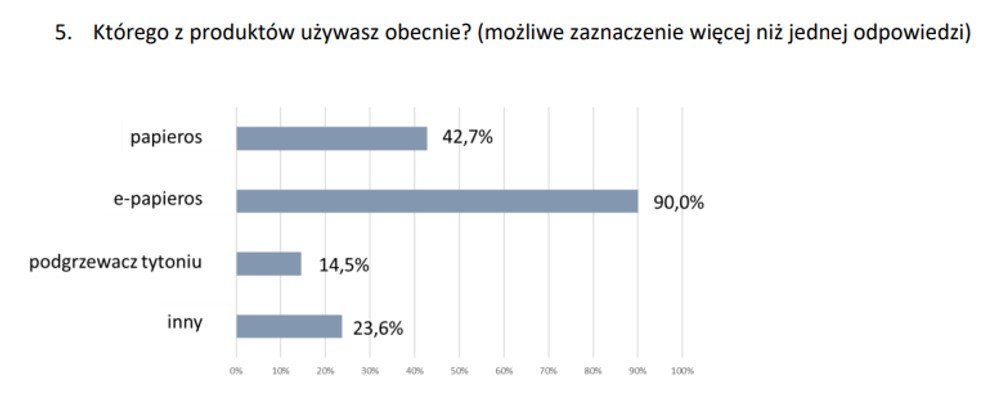
In doing so, the researchers note the alarming phenomenon of so-called " dual smoking" or " dual users." Young people today reach for nicotine from several sources: most often combining e-cigarette vaping with cigarette smoking.
- In schools, the cigarette epidemic has given way to an e-cigarette epidemic. 9 out of 10 students who currently use nicotine use it by vaping e-cigarettes. This is indeed a "plague" of Polish schools, to quote Health Minister Izabela Leszczyna. Most often, these e-cigarettes have flavors that are attractive to minors. They taste like fruit, candy or desserts - vaping such flavors is declared by nearly 83 percent of students using e-cigarettes. In Poland, there has been a lot of talk recently about disposable e-cigarettes, but we also have reusable e-cigarettes for replaceable liquid capsules, which pose the same risk to youngsters, because they contain identical flavors. The problem, therefore, is not so much the devices, but the attractive flavors of the liquids used in such devices," says Prof. Krzysztof J. Filipiak, MD, president of the Polish Society for the Advancement of Medicine - MEDICINE XXI - Seven EU countries are currently working intensively to withdraw disposable e-cigarettes from the market. In Belgium, they will be banned as of January 1, 2025, and will disappear from store shelves. The Irish Ministry of Health recently announced a similar intention. In our country, sad to say, we are losing the battle against the e-cigarette lobby. We are unable to complete even one law that would protect minors from vaping, and we know from press reports that we are also failing to tighten fiscal policy in this regard. The result of this inertia on the part of policymakers? Today flavored e-cigarettes, tomorrow alcohol in colorful tubes for children. Those making money from these "scourges" are very effectively taking advantage of this lack of decisive action by those in power, the expert adds.
One in two students buys nicotine products on their own
According to the survey, nearly half of the students (46.3 percent) admit that they easily purchase nicotine products on their own at a store or kiosk, despite the current ban on their sale to minors. In contrast, 9 percent of the students say they purchase e-cigarettes from online stores.
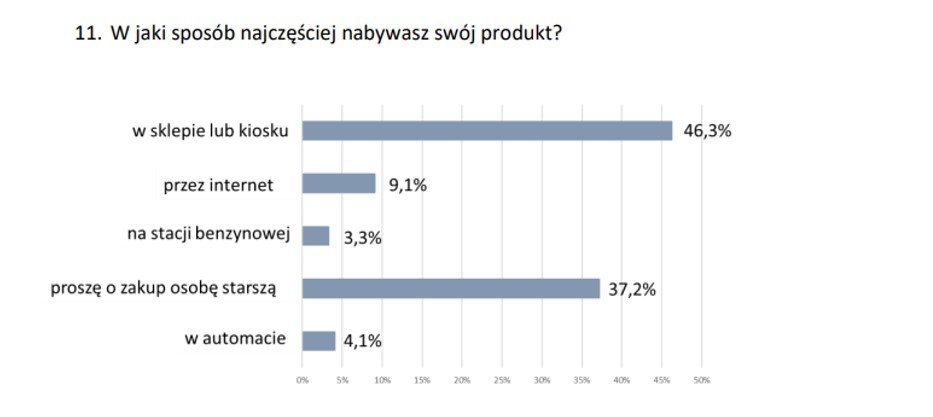
The results measured in the Polish Society for the Advancement of Medicine's MEDICINE XXI study are therefore close to those of the earlier PolNicoYouth study, conducted on behalf of the National Institute of Public Health - PZH.
- Cigarette smoking is one of the leading causes of lung disease and deaths due to damage to the respiratory system. Nowadays, young people are starting their nicotine addiction with flavored e-cigarettes that look like they were made for children. Our current ban on the sale of nicotine products to people under 18 only works on paper, but no longer in real life. Therefore, the medical community has long been signaling to the Ministry of Health the urgent need for a law banning so-called flavored e-cigarettes. These products should completely disappear from store shelves. We hope that the experts' appeals on this issue will finally be heeded," says Piotr Korczynski, MD, from the Department of Internal Medicine, Pneumonology and Allergology at Warsaw Medical University, one of the authors of the study.
The young admit that the main reason they try nicotine products is curiosity about their taste.
- The multitude of flavor variants has already made nicotine products the new candy. Nicotine products themselves look like candy. Let's remember that children are more susceptible to sensory stimuli than adults. And the marketing of nicotine products, especially sweet-fruit e-cigarettes, targets precisely the youngest, masking the true face of addiction. Calling a spade a spade, this is a hunt for children. Why do such e-cigarettes stand in stores next to candy? Why are they at child's eye level? Why do they have colorful packaging? Why do they promise a flavorful experience? Why do they cost pennies? For a young person, spending 30 zlotys on such an e-cigarette is no barrier to entry into addiction. More important for him is the realization of the need to "feel grown up" or the opportunity to "impress" among his peers," says Dr. Piotr Wierzbinski, a psychiatrist.
The vast majority (95 percent) of students say they are aware of the health consequences of using nicotine products. Despite this, their current use is declared by one in ten students. Significantly, only 2.5 percent of students who use nicotine openly admit that they feel addicted.
The report "Use of nicotine products by adolescents in Poland. A survey in the school environment" is available on the website of the Polish Society for the Advancement of Medicine - MEDYCYNA XXI: https://www.ptpm.org.pl/badanie-uzywanie-produktow-nikotynowych-przez-mlodziez-w-polsce/
About the study
The survey "Use of nicotine products by youth in Poland. A survey in the school environment" included a total of 1,380 students, mostly 13- and 14-year-olds. The survey was carried out by CBOS using the auditory interview method: elementary school students (grades 7 and 8) were given anonymous questionnaires to fill out on their own, in April-June 2024. The commissioner of the survey was the Institute for Health and Democracy, the contractor was CBOS, the factual preparation of the report was prepared by a team of experts from the Polish Society for the Advancement of Medicine - MEDYCYNA XXI.
Report authors:
- Prof. Krzysztof J. Filipiak, MD - Institute of Clinical Sciences, Maria Sklodowska-Curie Medical University in Warsaw; Department of Hypertensiology, Angiology and Internal Diseases, Karol Marcinkowski Medical University in Poznan; President of the Polish Society for the Advancement of Medicine - MEDYCYNA XXI.
- Piotr Korczynski, MD, PhD - Department of Internal Medicine, Pneumonology and Allergology, Medical University of Warsaw.
- Agnieszka Jankowska-Zduńczyk, MD, PhD - College of Family Physicians in Poland, AGAMED Specjalistyczna Praktyka Lekarska, Warsaw.
- dr. Stanislaw Surma - Department of Internal Medicine and Clinical Pharmacology, Department of Pharmacology, Silesian Medical University in Katowice.
- Prof. CMKP Sebastian Szmit, MD, PhD - Department of Cardiooncology, Medical Center for Postgraduate Education, Institute of Hematology and Transfusiology in Warsaw, Department of Oncological Diagnosis, Cardiooncology and Palliative Medicine, Maria Sklodowska-Curie National Cancer Institute - National Research Institute in Warsaw.
- Dr. n. med. Piotr Wierzbinski - Psychiatric Clinic, Lodz.
Topics
nikotynizm