The Supreme Audit Institution has published a report on the provision of public information by government entities. In 2021, the health ministry received the most requests for public information. How about the implementation?
NIK on public information requests. How did the health department fare?

Published April 25, 2023 08:00

The NIK recalls that access to public information, guaranteeing openness and transparency in the activities of entities performing public tasks, is a constitutional right of the citizen, and is implemented primarily through the provision of public information upon request and the publication of information in the BIP.
The right to public information is subject to restrictions due to, among other things, classified information, other legally protected secrets, the privacy of individuals or the secrecy of the entrepreneur.
After more than 20 years of the Law on Access to Public Information, its provisions still raise many interpretive questions.
The Supreme Audit Institution (NIK) has published its audit findings. How did the Health Ministry fare?
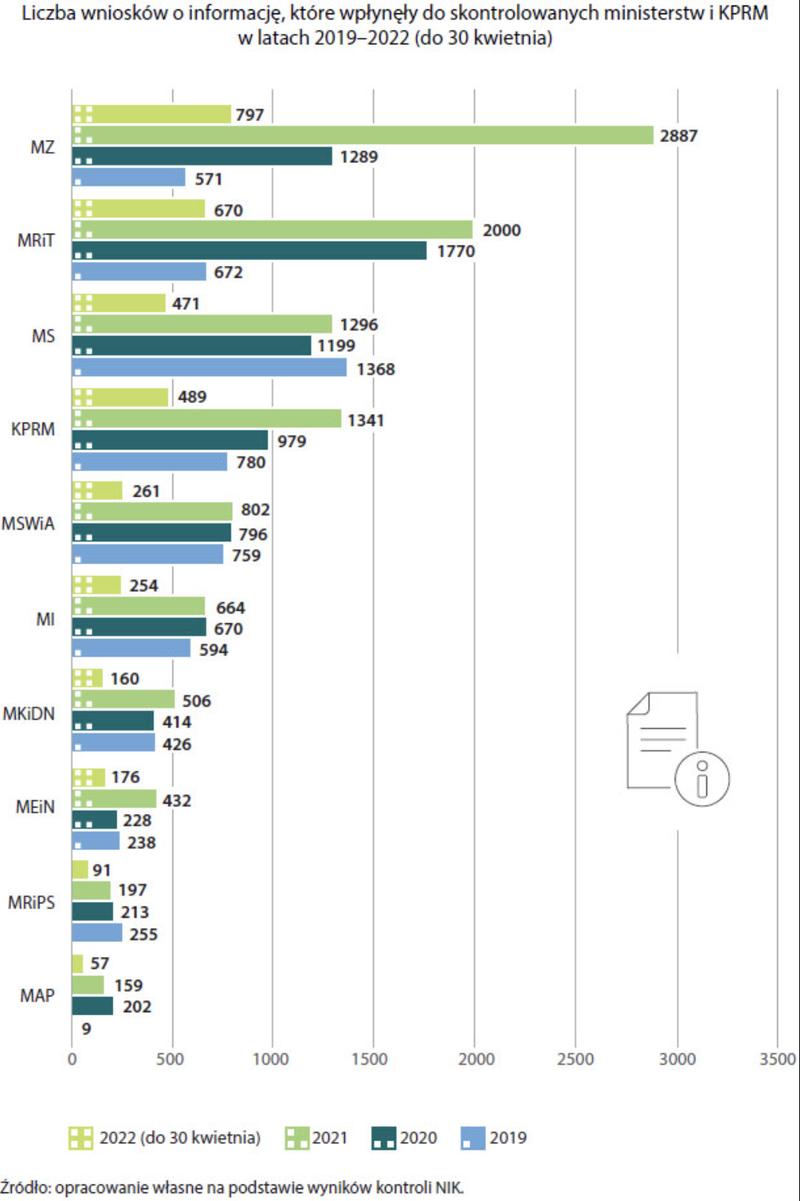
The chamber's data shows that it was the health ministry that received the most applications in 2021.
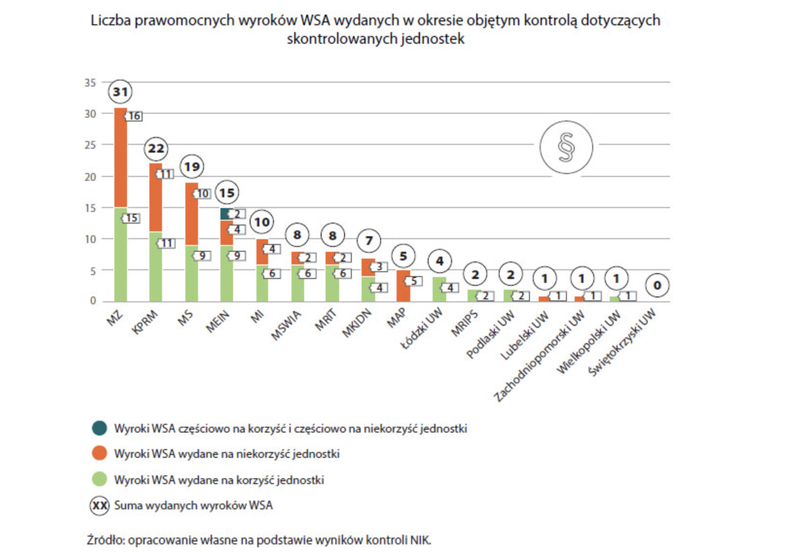
When applicants filed complaints to the Provincial Administrative Courts against the authority's decision to refuse to release public information or against the authority's inaction, there were judgments in the courts - a total of 136 in the period under review - nearly half of which were issued to the disadvantage of the authority obliged to release information. All final judgments have been implemented. During the period under review, the MZ remains the leader in the number of judgments - including those against the ministry.
In five audited offices, inspectors found unreliably maintained records of cases involving the release of public information. Two ministries (Justice and Health) did not update datasets in the data portal (dane.gov.pl) with the frequency they had adopted, which was an unreliable action.
In as many as 12 of the 16 audited offices, measures had already been taken during the NIK audit to rectify some of the irregularities found.
Ministries and provincial offices not covered by the NIK audit provided comments and observations on the provision of public information. They pointed out, among other things:
- The lack of definitions in the law for, among other things: public case, processed information, internal document - which creates interpretation problems and necessitates each time a time-consuming analysis of the case law of administrative courts, which is inconsistent and changeable;
- the growing number of requests for information that would be used for educational or professional purposes (e.g., data for writing a scientific paper), the preparation of which requires the involvement of multiple organizational units of the office;
- the difficulty of processing information requests that require significant work due to the broad scope of the request or the complexity of the case.
Applications
Requests to bodies obliged to provide public information
- Strengthen oversight of the implementation of obligations related to the release of public information, in particular the timely processing of requests for public information.
- Take measures to ensure the publication of public information required by the udip regulations, regardless of its posting on the BIP website by other obliged bodies.
- Marking information published on the GOV.PL portal as BIP content to ensure its display on the Bulletin.
De lege ferenda conclusions
The Supreme Audit Institution requests the Council of Ministers to take legislative action to:
- Clarification of Article 13(1) of udip by indicating that the time limit specified in this provision for the release of public information upon request also applies to situations other than the release of public information, including, among other things, informing the applicant that:
- the subject of the request does not include public information within the meaning of udip,
- the requested information has already been made available on the BIP or data portal,
- authority does not have the information referred to in the application,
- regulations that have priority shall apply (Article 1(2) of the udip);
- Clarifying the provisions of Article 16 of udip by specifying the time limit within which a decision to refuse to release public information and a decision to discontinue proceedings are issued.
Source: NIK