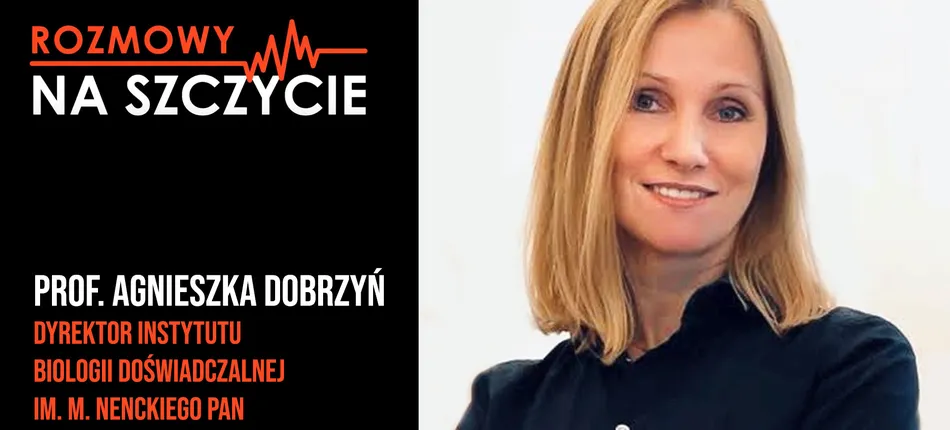
Polish science has much to boast about. We have excellent inventions and discoveries, but only a handful of them end up in clinics. Why is this happening? Who is to blame? Does the scientific profession in Poland have a future? Prof. Agnieszka Dobrzyn, director of the Marceli Nencki Institute of Experimental Biology of the Polish Academy of Sciences, talks about the barriers, successes and hopes.
Summit Talks
Great ideas and nothing... What is blocking Polish science?

Published May 8, 2025 10:55
Does Polish science have something to boast about? We are, of course, talking about the area of biomedicine.
Yes, in addition to being a researcher for more than 20 years, I am also the director of the Necki Institute, which is the largest scientific center conducting research in the discipline of biomedical sciences. All of our projects are related to understanding how an organism should work and what causes disorders and disease development to suddenly occur. In such a discipline, we are good as scientists and recognized internationally. On the other hand, a very large part of the research carried out at scientific institutes is basic research, giving us answers as to why a cell or an entire organ stops functioning properly. Often, when we manage to find that answer, we publish great scientific papers, while later nothing happens in terms of implementation in the clinic. This is one of the things that should certainly be changed in Polish science and the scientific, biomedical community.
I look at the data: in 2023 alone, a record number of applications to start clinical trials were registered in Poland. For example, in the area of hematology there are a lot of them. What happens after that? Clinical trials are conducted?
Yes. It's interesting to note that there is actually a lot of clinical research going on in Poland, but it's mostly commissioned research by large foreign biotech companies that have branches in our country and benefit from access to patients and doctors. They are conducting clinical trials, which is of course a good thing, because if we have a new drug that has been tested, it will also find its way to the Polish market, and we will all benefit from that. On the other hand, if we wanted to look at how many clinical trials of medical compounds or medical products that have been developed in Poland, we would be greatly surprised, because in fact I know of maybe two such cases where inventions made in Poland or discoveries made by Polish scientists have made it to clinical trials. And this is one such thing that concerns me personally.
And what is the reason for this?
I have my own theory on the subject. Someone may say that we don't have enough money for research. Yes, we don't have enough money, but there is research that has been well-funded, groups of scientists who are really great, research results that are very promising from the point of view of application in the clinic or implementation in the biomedical market, and nothing happens... I see that we lack systemic experience of what to do with promising results of basic research. That is, how to convert them to translational research and then to implementation in the clinic. We are currently trying to implement a completely new way of approaching basic research at the Institute. Namely, already at the level of basic research, the kind that is obviously translational in the clinic, because we only do such research at the Nencki Institute, to join a group of scientists - clinicians, that is, people who know how the work is done and what the mechanisms of drug implementation and later drug use in the clinic look like, plus a contact for people who know how to commercialize the research. To a large extent, these are neither scientists nor clinicians or doctors, but are people from the business community.
Such a team is formed to bring the research from start to finish?
Yes. And note that if we have a great scientist in the team, who knows how to do scientific work, we have a clinician who will say to this scientist: hey, to you it seems that such a medical device would be good to use in the clinic, but I know how the work in the clinic is, there is no way that such a complicated tissue preparation procedure can be done in the patient. Therefore, think of something else. Then the scientist comes back and we can think of something else, only we need to know at this early stage to think differently. And at the same time we work with someone from the business environment he tells us: listen, the idea is great, it looks very cool scientifically, the results of preclinical studies are good, while translating it into business, that is, scaling it up, producing it in large numbers and very quickly - this will not work. When a scientist has this information beforehand, he or she is able to think differently, so that it happens, however, that we come up with something that can be applied easily in the clinic and something that is easily scalable.
This team you described is already a practice or a song of the future?
This is something we have already been practicing for two years at the Nencki Institute. We call it a mentoring program, that is, we connect scientists with a businessman and with a clinician at an early stage. We have already done such a pilot study in 2018, it was successful in the sense that we are already at the stage of setting up a special purpose company to create a test for early diagnosis of Alzheimer's disease based on microRNA, where we have investors from outside Poland. And this way of thinking has worked for scientists at the Nencki Institute. We showed the results of our work at the Ministry of Science and Higher Education to Deputy Minister Prof. Ms. Mrówczyńska, whom I thankr for noticing this potential. We received funding for another pilot mentoring for people from Poland, no longer from the Nencki Institute.
Is this the Stanford mentoring program?
This type of program was developed not by us, it was developed at Stanford University, where we went, saw how pn works and signed a bilateral agreement. It's called SPARK. Now we are creating SPARK Poland. And we are trying to implement it in Poland. I believe that by doing so, more of these good scientific ideas will be implemented in the clinic.
Will this make biomedical technologies such a Polish specialty?
So far they are not, but it would be wonderful if they were. It is not true that good ideas are born overseas or in a particular country. In fact, good ideas are born everywhere. There is no such thing as an address for good ideas.
So it's not a question of finance just a question of building a certain support system?
Finances certainly do. Without money we won't do anything. As I observe the way science is funded, there is certainly not enough money, but if projects are already funded, they are funded well. The amount of money allocated to these heavily selected projects, allows us to do research at a very high level and get very specific scientific results. On the other hand, what happens afterwards is most often that the scientific result is published and that's it. That is, these results can be used by all companies that have access to the publication, but it doesn't go directly to the clinic. Perhaps your editor remembers Professor Martin Dryg and the time of the pandemic....
You also did a project of such a genetic test?
Yes, I was in charge of a project called SONAR. It concerned group testing for coronavirus in people without symptoms, and that worked out great for us, too. Of course, we reserved the patent and trademark rights to SONAR. We have the license sold. In the event of the next epidemic, which I hope we don't live to see, it's ready. This is one such example. The second example, Paxlovid, which is the only coronavirus drug in operation today. It was developed in Poland by a group of just Prof. Marcin Dr¹g, who figured out how to inhibit one of the enzymes in coronavirus. He published it, and it was used by the company that prepared the drug. And we are happy, because this drug is here today. On the other hand, it's a pity that it's not being talked about, that it was developed in Poland. And probably to the question of whether this drug could have been made in Poland, I would answer today that no. That's because we don't have the kind of economic environment that we have in the States, but the idea is there. So if we had just worked on that environment, it would have produced the kind of results we would be proud of.
Then perhaps it would still be useful to have someone on this team, from promoting the successes of scientists?
To make us proud. Yes, this is one of the things that we scientists are not good at. We know what we're doing, we put a great deal of work and effort into it, but if the public knew how many good inventions are made in Poland, we would just be proud. Certainly I am proud of the people I know.
You mentioned that scientist is a profession, and do young people despise it?
This is precisely one of our ills. That's why talks like today's are so important, because we can say that this profession can give great satisfaction. It's nice to do something that causes a certain change in the way we live. It's worth telling young people that this is the profession of the future. I can't imagine that artificial intelligence can supplant real intelligence.
Isn't that a threat?
For our profession, artificial intelligence is just a tool and a support, and it is certainly not a threat. Scientist is a profession that is not strongly popular today, and it would be good to change that, because it is very attractive not only because we have full freedom of what we work on, but I can safely say that if one is good, it also gives financial satisfaction. This is something that young people are looking at today. I often meet with young people and say openly: yes, you can also have financial satisfaction. It is not true that scientists are people who cannot survive from first to first. Provided they are good at it.
Professor and what are you working on now? What do you see as a source of satisfaction and hope for patients?
I'm in charge of diabetes, and now I have two such projects that I'm extremely proud to have brought them to the stage we dreamed of from the very beginning, starting work more than 20 years ago.
The first project is a bionic pancreas. It is often talked about by Prof. Michal Wszoła, my colleague. The bionic pancreas is an organ produced in the lab using 3D technology, just like 3D printing. Only we use biological materials, to which we also add living cells that secrete insulin, that secrete glucagon. We are able to make vessels in this lab-made organ, we are able to transplant this organ into the body, and ladies and gentlemen, this organ functions! We started, of course, with basic research in the lab in vitro on cells. Then we made small organs, which we transplanted into small animals, namely mice. The mice function perfectly. Then Professor Wszoła did transplants to large animals, namely pigs. And with this set of results, we already have approval and money to enter the clinic. In the middle of 2026 we will do the first bionic pancreas transplant not only in Poland, but also in the world.
Is this an opportunity and hope for oncology patients, for example?
The bionic pancreas transplant is an opportunity and hope for people with diabetes, although our target group for the first bionic pancreas transplants will be people with chronic pancreatitis. Chronic pancreatitis, not only is such a disease entity where patients have tremendous pain discomfort, it very often transforms into pancreatic cancer. So the approach is that we remove a pancreas that is already in a very dangerous state in terms of progression to cancer, and implant instead a pancreas that will be functional in terms of maintaining glycemia, that is, maintaining normal sugar levels, that is this first attempt we are making.
And the second project?
The second project I have just started is funded by the Medical Research Agency. We will be constructing a prototype device already, which will be a test that will allow very early diagnosis of type two diabetes. Type two diabetes is usually diagnosed when we have either glucose levels that are too high, or accidentally when we have other tests. We know that the onset of type two diabetes begins a few years earlier, when already insulin-resistant tissues, that is, tissues that stop responding to insulin, secrete certain compounds, these go to the pancreatic islets, which begin to respond in just this way. This will be a test for capturing very early markers of early diabetes and early development of insulin resistance.
I believe that a pathological condition diagnosed early can still be one that we can reverse. Today, when we have a diagnosis of type two diabetes, the only thing we can do is to maintain glycemia, that is, to lower or raise blood glucose levels. On the other hand, we can no longer reverse it. I believe that if we catch early enough that something is going on, there will be a moment when we can still go back. That's why it's so important to diagnose early. We'll be starting work, we have to finish by March 2026. A lot of work ahead of us, but it's the kind of work we're excited about.