If one were to compare transplants to physics, two-organ transplants would certainly be quantum mechanics. Why? They require a great deal of knowledge, experience, skill and imagination from the specialists performing them. Simultaneous transplants of more than one organ are performed only in the most advanced centers, such as the University Clinical Center, which leads the country in this area.
Dual-organ transplants - a challenge worth taking on

Published June 10, 2025 11:03
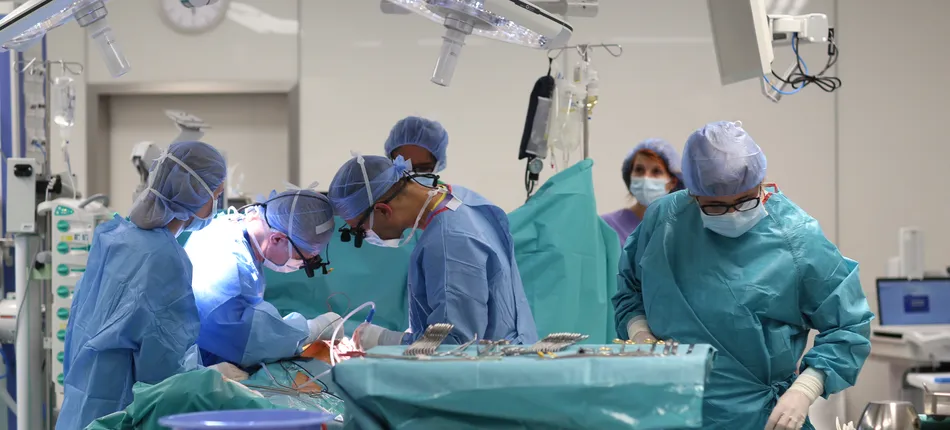
Patients who have suffered extreme failure of more than one organ, preventing normal functioning or even life-threatening, have limited treatment options. Moreover, in the past, this fact deprived them of the possibility of benefiting from transplantation - the failure of one organ disqualified them for transplantation of another. Currently, thanks to the rapid development of medicine, two-organ transplants - operations that are much more complicated than single-organ transplants both in terms of performing the procedure and logistics - are being performed in some highly specialized centers.
One of the largest transplant centers in Poland is the University Clinical Center in Gdansk, where, in addition to traditional transplants of kidneys, lungs, livers, hearts, corneas and bone marrow and hematopoietic cells (a total of 504 such operations performed in 2024), simultaneous transplants are performed in the following configurations: kidney with liver, kidney with heart, kidney with lung and lung with heart. Transplants of this type involve two teams that enter the operating room in succession, very often at night.
First simultaneous transplants in Gdansk center
Dr. Piotr Siondalski of the Department of Cardiac Surgery, who coordinates the heart transplant program at UCK, recalls the first transplantation of a heart and kidney taken from a single donor, initiating two-organ transplants at UCK. - We performed such a therapy for the first time in 2018. After implanting the heart and stabilizing the patient, the kidney transplant was performed by a second team of surgeons. Previously in Poland, only Professor Religa's team performed such a complex procedure. Performing simultaneous, multi-organ transplants requires overcoming many barriers. From proper patient classification and risk assessment, to overcoming logistical and psychological difficulties, fears that something will go wrong at many stages of this treatment. Belief in the success and restoration of the patient's health is a prerequisite for the medical team. It is necessary to skillfully convey these values to the patient, persuading him or her to embark on such a distant and dangerous expedition," he points out.
A total of 3 simultaneous heart and kidney transplants have been performed at the University Clinical Center. In contrast, a kidney together with a liver was transplanted for the first time at UCK in 2024, and there have been 3 such simultaneous transplants to date.
An opportunity for dialysis patients
- Simultaneous liver and kidney transplantation is a great opportunity for patients on dialysis, with kidney failure or perhaps not yet dialyzed, but who will have to use this form of therapy in a while and have liver failure at the same time, i.e. have two failing organs," points out Prof. Alicja Debska-Slizien, head of the UCK Department of Nephrology, Transplantology and Internal Medicine, who heads the kidney transplant program at the Gdansk center.
- Managing and caring for such a patient is obviously more challenging. The patient may have drops in pressure, may have fluid shifts between the vascular bed and the extravascular space, and so is a much more difficult patient to manage," stresses Piotr Domagała, MD, who heads the liver transplant program at the Gdansk center. - In the case of simultaneous lung-kidney and heart-kidney transplants, the kidney often takes up function with a delay of several days or even weeks, meaning it requires dialysis. It is slightly better in the case of simultaneous liver and kidney transplantation when the kidney usually takes up function with only a slight delay after the liver, adds Prof. Debska-Slizien.
Organ ischemia time is a key issue in transplantation
The process of simultaneous kidney and liver transplantation itself takes longer than a single procedure - about 9-10 hours. After the liver is implanted, the patient is repositioned and only then does the surgeon proceed to implant the kidney. A key issue in two-organ transplants is the ischemia time of the organs used in the operation, which tells how long an organ can stay out of the donor and recipient bodies. Kidneys tolerate a longer ischemia time better than the liver, which can stay out of the body for a maximum of about 8-12 hours. In the case of the kidneys, the time is 24 hours or even 48 hours when we use the kidney perfusion machine that UCK has. There are times when kidney transplantation is postponed, but in Poland, usually the transplants take place one after the other.
At the University Clinical Center, kidneys are also transplanted with lungs - the first successful transplant of this type in Poland took place just at the Gdansk center in 2023 (a total of 2 such transplants have been performed at UCK). The lungs in this case are implanted first. This is due to the fact that the maximum ischemic time for lungs is 6 hours, which is much shorter than for kidneys. As for other transplants in the lung configuration, three simultaneous heart and lung transplants have been performed at UCK so far - the first time in 2022. It is worth noting that these were the first such successful operations in Poland in 20 years. In this comparison, it is the lungs that are more resistant to the lack of active blood supply.
- We conduct the operation in such a way that the heart does not have a longer ischemic time than four, four and a half hours. If we are comfortable with time, we first try to do what is technically difficult after the heart has been sutured, namely bronchial anastomoses. These are easier to do if the heart has not yet been sutured. But if time is pressing, we have to implant the heart first and get it running, and only later, even though it is more difficult, deal with the anastomoses on the bronchial tree," says Jacek Wojarski, MD, from the Department of Cardiac Surgery, coordinator of the lung transplant program at UCK.
The big challenge in this case is qualification. The donor must be selected so that both the lungs and heart are the right size to match the recipient.
Transplantation is a team effort
It is said that transplantation is a team effort that sometimes involves up to a hundred people, but in this case that number is even higher. Transplant coordinators oversee the entire process. During multi-organ transplants, a large team of surgeons and anesthesiologists, instrument and anesthesia nurses, and a team of perfusionists operating the extracorporeal circulation apparatus work in the operating room for hours. Before and after surgery, the support of physiotherapists and psychologists is essential. However, transplantation would not take place if it were not for the organ procurement teams and if a specialist in the field did not qualify a particular recipient for transplantation. The donor and recipient are linked together through the Poltransplant system.
Patients qualified for two-organ transplantation are high on the waiting list. Qualification for this type of surgery is much more demanding than for single-organ transplantation. Apart from the aforementioned specificity of specific organs and selection criteria, in addition, the patient must be in good enough condition for his body to cope with a double transplant. And even though this type of surgery is much more difficult, the fact that it is often the last treatment option and the only chance to save the patient's life makes it worth the risk. Of course, it is not always possible to find a single donor of two organs. Patients in this situation can have a second organ implanted at a later date. This applies to patients who received a liver, heart or lung as their first organ and require further dialysis due to kidney failure.
- However, it should be added that the survival rate of patients after simultaneous transplantation of two organs is better. The recipient receives organs from the same donor, that is, with the same tissue compatibility antigens. This reduces the immunological risks and side effects of immunosuppressive treatment," adds Prof. Debska-Slizien.
A total of 11 two-organ transplants have been performed at UCK. Preparations are currently underway for a liver-lung transplant. Simultaneous transplants are also performed at centers in Warsaw, Szczecin, Katowice and Zabrze.
Source: UCK in Gdansk