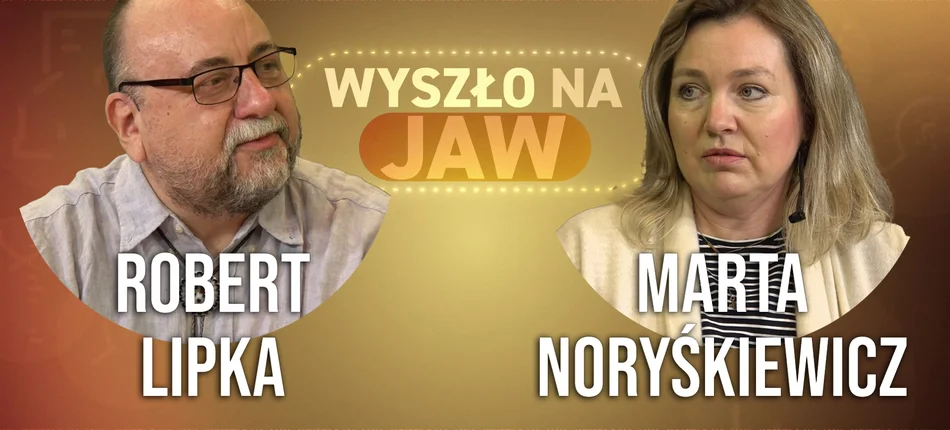
Are we born with a desire to help? Does it pay to help? Or is a good person a foolish person? Is there a black side to helping? The guests of editor Bozena Stasiak are Marta Noryśkiewicz, psychologist, psychotherapist, and Robert Lipka, cultural anthropologist.
It came out to Jaw
What is it about helping?

Published April 17, 2024 09:00
There's a reason I've chosen our guests today this way, because we'll be talking about helping. During the conference on bone marrow transplantation, you said that our brain is oriented towards helping. And very often it may be that just helping may simply be therapy. What is the point of helping? Does it mean that helping is in our blood, that we are born wanting to help?
Marta Noryskiewicz: The issue is very complex. Certainly, my statement referred to the part in the brain that we have in the prefrontal cortex. These are the mirror neurons. Mirror neurons help us feel empathy and feel the situation in which the other person is. We can also relate this to helping, of course. When I feel, not participating in an event, but, for example, seeing someone on the street kicking a dog (I don't have to participate in the event, I'm not even that dog), but huge layers of empathy are activated in me, because I empathize, I see. So empathy, as well as all the emotions that follow it in the situation of such a scene, help me react and do something. But this is one aspect of how our brain is built. Helping is a very complex matter and is affected by many more different aspects.
I address the same question to Mr. Robert as an anthropologist. Are we born with the desire to help?
Robert Lipka: Indeed, when a young individual of the species Homo sapiens sapiens, or ours, is born, I must say that there is neither good nor evil in our brain. On the other hand, there is genetic equipment, drives, instincts that can be used in both directions. This is already a matter of culture and social upbringing, socialization. But in general, evil and good at the level of biology does not exist. There is the equipment of herd and social man, and therefore cooperative. This was a very good example of the previous speaker with the dog. Indeed, when a person is damaged, damaged prefrontal cortex, he will be capable of extraordinary, drastic acts. And the culture? Yes, empathy is also awakened in me when I see a persecuted dog. But in China, the other Chinese may then say: hit him harder, he will be tastier. I remind you that in Chinese, an animal is literally a thing that moves. And actually there is a coevolution of our genetic heritage and cultural norms of social life. We mellow from generation to generation. Against all odds, against the wars, we are gentler.
We already have a bit of an answer to the question I wanted to ask, which is that some people have this desire to help and some don't. Because not only some factors we have in the brain, but also cultural factors have worked. Is it possible to define a person personality-wise who has the desire to help in him?
Marta Noryskiewicz: You can. I don't know if I will refer to the personality, but I will certainly refer to the emotions. The most recent research was undertaken in 2022, when a very large number of refugees from Ukraine came to Poland and there was a rush among Poles, i.e. everyone helped as much as they could. And this phenomenon sparked research on helping. It turned out (and this is nothing revelatory) that happy, fulfilled people, whose lives are fully balanced, help. And this is such a very healthy helping, because they then have the space to get out of their ego level, self-centeredness and give something to other people. This is very beautiful and healthy helping. On the other hand, people who are unhappy, sad (anger is a big block and stands in the way of helping) focused on themselves find it difficult to take a step towards other people. In general, it is difficult for them to connect with other people. They help people who are connected to the world and nature, reconciled with themselves, and it is not related to financial status, because happiness does not depend on it, money does not give happiness. They give for a while to the most poor, but then this also gets habitual, they are just rich internally, at a certain level of development of their consciousness. They have something to help and give from. They have some resources of their own, and this is also combined with a sense of happiness and balance.
That is, one would have to be happy first, and then have the desire to help. How does an anthropologist look at this?
Robert Lipka: I can only applaud the words just spoken. But the basic point is this: yes, altruism is a characteristic of our species. Even if we analyze the life strategies of individuals of our species, moderate altruism is a very good strategy. Of course, this does not go into what is being addressed in psychology, while we indeed have a social soul, because we are a social species. If we don't help, we lock ourselves into a world where crises will be worse personality-wise.
And sometimes one hears that a good man is a stupid man. Is there something in that?
Robert Lipka: No. One doesn't have much to do with the other. We aspire to occupy higher places in the social hierarchy, that is, to accumulate social, sociological power (it's called differently), but if someone shares a piece of bread, he is wiser. Money does not give happiness. Some add - but it allows you to do without it better. But it's better to be happy. American studies are very cool, they show that a rich person is not as happy as a not-so-rich person. We must have money and some material resources to survive, to live normally without anxiety and stress. But if smiling other people come into our lives, it lifts us up. A simple, beautiful study. When I was on an internship in America, Americans of Polish descent very often end their wealth at the level of $950,000 (that was 20 years). Why? Because at this level of wealth, the father-to-be still plays the role of father, takes his children on his lap, takes an interest in how things were at school. And when the company eats up his time until the end, he's gone. What psychology also probably sees in therapy - children with a cold father, deprived of a father because of work, trips, secondments have it worse.
Let's go back to the conference that Ms. Marta attended. There, recipients and donors spoke out. As for the donors, it was very touching that they emphasized how much good they had obtained, what helping gave them. And if we were to take this to a more general level now, what does helping give a person? You stated that it can be seen as therapy. What does it give the giver of good to help?
Marta Noryskiewicz: It's hard to even put it into words. You just have to start experiencing in some, perhaps small, areas. Helping is gold itself. When I help I have a greater sense of agency, I have a greater sense of meaning, I feel that I can give something to the world, and so I see more value in myself. When I help I turn my attention away from myself, from my ego, I get out of my perspective and I am more connected to other people, to the world. When I help I literally open my heart, I experience higher feelings (just altruism is one of the higher feelings), which distinguish us from animals. And this literally changes the biology in our bodies. We feel happy, we feel proud, we feel causal, we feel a sense of meaning, we see that we can contribute to some aspect of life. So it is really a beautiful feeling.
I, however, have the impression that in our time this desire to help has become, I won't say unspectacular, but as if neglected.
Robert Lipka: A small correction regarding the fact that altruism differentiates us from the rest of the animals. A male zebra in defense of his cubs can commit suicide in the mouth of a lion. But indeed altruism is our species trait. Altruism for show is not true altruism, because altruism is the building of the fullness of humanity.
But what is happening to us as a people that the desire to help is fading in us, however.
Robert Lipka: No, I don't think so. More and more I see rather such export forms of helping, that is, helping for show, so that there are nice videos or so that everyone says: oh how he helps. No, that's not bad at all, but it's still not what it's all about. An example (perhaps many will be touched by) helping Africa. There are many missions, people getting involved, who build wells. Seemingly a good thing. But what is the effect? One of the poorest countries in the world has six births per woman, which means they are putting their hand up to create a demographic wave that could flood the world, and they don't have a livelihood. Paradoxically, perhaps China is better off helping so-called black Africa, because it is building factories there. One is given a fishing rod, not a fish. So there it is. One has to think. For those who don't want to think about altruism I would have this advice - become a blood donor.
How, therefore, to help on a daily basis? In what way? Can help be a smile or something concrete? How to help so that we feel happy to help, and at the same time the person we are helping does not feel humiliated, embarrassed by this help?
Marta Noryśkiewicz: You can make a whole list, because there are a whole bunch of ways to help. You can take a plastic bag, go to the park and pick up trash there. Then no third person is involved, yet I am doing something for the sake of others and for the sake of our nature. Let's be attentive to other people. We observe a little what people need, what our neighbors need. You can walk someone's dog, water their flowers, ask how they are feeling, listen to at least someone. This is a terrible deficit, because people need attention so much, and they don't get it. So it doesn't have to be material help, or help related to our physical effort. You can send someone a nice text message, such as "how are you?" or "have a nice day." Technology now makes it very easy for us. What really matters here is the intention. Do I really want to help? Would I like to enter into this experience? There really will be a whole lot of ideas. It seems to me that the less spectacular the help, the more beneficial it gives.
It doesn't have to be a bag of gifts.
Marta Noryskiewicz: No. I wouldn't connect this with gifts and gift-giving at all. These are completely separate categories of processes.
Robert Lipka: Support is multidimensional. It's not just this bag of gifts, but social support. It is just from smiling starting from helping someone overcome a certain crisis that may occur in someone. In fact, it is the struggle against loneliness. This is perhaps the biggest threat at the moment, especially for seniors. In spite of appearances, modern communication devices separate people from each other. I'm watching young people talking to each other now. They sit on a wall of ten and each looks at a smartphone. Nothing good will come out of this. Besides, you can already see it in other surveys that young people are getting a little stupid. In truth, I would conclude with such a Buddhist saying - when the student is ready, the master will be found. When you are ready to help, you will find for sure.