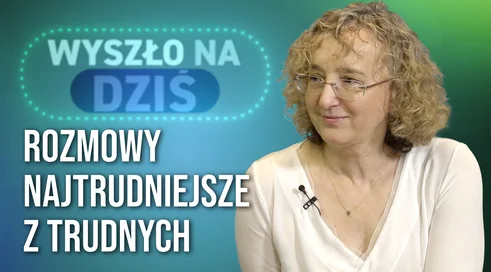
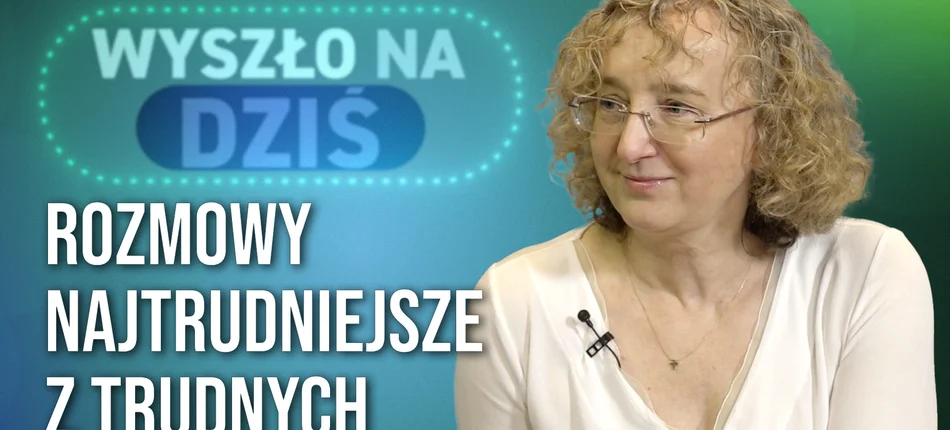
- Finding out that a child has cancer is the worst situation in a person's life that can happen to him. There is no single formula for how to convey such information. I've been working for more than 20 years, and I always thought it was better to tell the truth. Now I think it's not. Not everyone is ready to accept this truth," said Prof. Anna Raciborska of the Mother and Child Institute in a program on Wyszło na Dzisiaj on the Wyszło na Zdrowie channel.
Cancer in a child. Not everyone is ready for the truth

Published Aug. 16, 2024 09:00
Diagnosis of cancer disease is never easy. It is not easy if an adult, young adult or senior citizen hears it. And what happens when you have to tell your child's parents about such a diagnosis?
I believe that finding out that a child has cancer is probably the worst situation that can happen to a person. It is very often a huge shock. Questions arise: "why me?", "is there a God?", "why did this happen?", "what did I do wrong?" and "does my child have a chance?". And it's very difficult, because there's also no single formula for how it should be said. I've been working for more than 20 years, and I always thought that maybe it's better to tell the truth, but now I think not, because not everyone is ready to accept this truth. I believe that you can't take away anyone's hope. This does not mean, of course, that one should deceive someone.
I remember such a situation that the parents took the child from us to unconventional medicine for treatment. They later returned, but this child could no longer be saved, we had no chance to do so. I asked the mother of this child why she did that. She said it was actually because she got a 20-30 percent chance from us and decided it wasn't worth fighting. We did a meeting of the parents of our patients. More than half of them said they didn't want to know the truth at the very beginning. It's difficult, because I believe in conventional medicine, and I wouldn't want to cause a shift to unconventional medicine with my conversation and my approach or behavior. On the other hand, I know that I am obligated by law to tell the patient the truth, that is, to let them know what the prognosis is. I believe that telling the whole truth should involve good actions. If I see a parent for the first time, I don't know how much he is aware, how much he is oriented and how much his mental construction allows him to accept such a message. Ne everyone is ready to have their hope taken away or diminished. And the other side of the coin is that this is very difficult for us doctors as well.
What kind of burden is this on the doctor? After all, it is probably impossible to leave everything behind the walls of the hospital?
For us, conversations about a child starting treatment are not relatively difficult. I wonder what this parent will do, but often in such a conversation I say that I have plenty of options, including modern, personalized medicine, to save the child. For us, the most difficult conversations are those in which I have to say that I actually have to give up, because I have nothing left to offer the child, other than the kind of medicine that only alleviates the symptoms already. It's not that we are indifferent. Me thinks that sometimes parents may perceive conversations with us this way, think that we are insensitive, that it takes 10 seconds. It's just that it's an awful 10 seconds for us, too. Many of us are parents, and sometimes it's really very difficult to stand eye to eye with a parent and tell them that I don't have anything to offer anymore. We then have to go back to our lives, and it's not like closing the door behind you and not remembering it.
Any situation particularly memorable to you?
I really have a lot of such moments. Unfortunately, sometimes children pass away and parents are then very scared. One mom talked to me recently and told me that her son said: mom but this is not my story, mine is different. Once a seventeen-year-old boy came to me. I liked him very much and was shocked that I had to tell him that this is the end. He said to me "but life is like a flower" and brought me a bouquet of roses. I experienced it very much at the time, he sadly passed away. There was also a patient that I cried, telling him that he had to go to hospice. He told me not to worry, so the roles switched and it was he who comforted me. These are not situations that can be erased and shut the door behind you at sixteen.
And isn't it sometimes the case that it is the little patient who is the smartest or the one who feels the essence of the situation the most?
I think so, but let's remember that we are talking about children. As long as the patient is a minor the parent decides everything. So the work of a pediatrician or pediatric oncologist is very much a work with parents. Of course, I believe that children are very smart, children feel and often protect their parents. One of the worst-performing groups of patients are young adults, that is, patients between the ages of 19 and 25. They often don't accept that they can't live like their peers and very often don't fulfill the so-called compliance. In oncology, punctuality is important - coming to appointments, taking medications. These young people are often rebellious, saying that they are not afraid of death or that it does not concern them. They express their opinion, with this opinion not always being wise. Sometimes it ends dramatically.
And what is the role of psycho-oncologists?
Huge in my opinion, especially with those difficult conversations. The psycho-oncologist has a huge role in supporting the patient and his family. Sometimes siblings say: in order for me to live and be noticed, my brother has to die. This is because all the attention is focused on this sick child, so that healthy children are completely overlooked, and this is also a very difficult situation for them. The psycho-oncologist actually supports the whole family
And let's not forget that the medical staff also has its limits, and it is also very often the case that my psycho-oncologists are there to help my staff. Let's also remember that a psycho-oncologist is also a human being, and he too should have a place to unwind. After all, if both he and the doctor and nurse are burned out, it will translate to the patient.