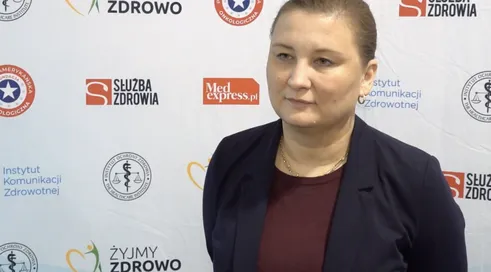
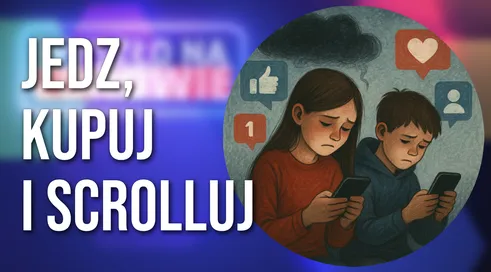
The holidays are getting closer and closer - and with them, the marketing offensive targeting the youngest is intensifying as well. Children and teens today spend long hours on social media, watching influencers, youtubers and creators who have become informal marketers of everything from toys to lifestyle. How do such messages affect young people's emotional and cognitive development? Dr. Aleksandra Lewandowska, a national consultant in child and adolescent psychiatry, talks about the consequences of kindermarketing, shopping pressure and junk food.
It came out in Health
nfluencers, gifts and pressure. How do social media and kindermarketing shape the needs of the youngest?

Published Nov. 26, 2025 08:02
Dr. Aleksandra Lewandowska, national consultant in child and adolescent psychiatry, is a guest on "Wyszło na Zdrowie". Dr. I extend a warm welcome to you.
A warm welcome to you Ms. Editor, welcome to you.
We are going to talk about a topic that is very important right now, when Christmas is approaching. In fact, already two months before Christmas we are being aggressively persuaded that we must necessarily buy something as a gift for our loved ones. I would like to talk about why our children are being fooled by advertising. Doctor, how does this ubiquitous advertising and all these marketing efforts aimed at our children affect their emotional and cognitive development?
They influence in a very significant way due to the fact that we are talking about children, that is, such a structure in terms of development, where yet cause-and-effect thinking is not always developed at such a level as in an older teenager or adult. All the time, this central nervous system is developing, where in children, especially in teenagers, there is an overactive limbic system associated with the emotional part, with the secretion of dopamine, that is, with seeking and undertaking activity, where dopamine levels are much higher. In addition, it should be remembered that the prefrontal cortex, which is responsible for the ability to control emotions, for impulse control, the ability to anticipate the consequences of decisions, matures at the latest in these young people. How we put this together with the lack of education at the grassroots in most families (we also know that not all children, not all adolescents attend health education classes), and how often this message directed to children and adolescents is based not on the value system that each of us presents, that guides our functioning, is the susceptibility of this developmental group to being bombarded with images, sounds that persuade you to consume and convey such a style of functioning that what you have defines you, what you are, and if you buy one thing, a second thing, a third thing it means you will feel better, you will be happier, and children and adolescents do not have the critical thinking developed enough and for them it is such a zero-one message, so these consequences are very serious.
I read recently that more than 50% of the fairy tales we read to children are stories of products that can be bought in the store. So this is also an even more perverse way of influencing young people. This kindermarketing is a great danger to a child's emotional development.
Absolutely yes! Such subliminal messages also appear in games, in various programs that are dedicated to children or teenagers. Let's keep in mind that a not insignificant part of children and teenagers have access to various content (mainly on the Internet), people who are significant for them, such as youtubers, influencers. Some of these people advertise certain products in their messages. Especially for a young teenager and child, an idol, an authority figure, in their ruminations and understanding, who shows and says: if you have this or buy this product, you'll be happy, this is very difficult to put together when the guardian parents don't have the attentiveness and insight to consider who this child is watching or what they are watching online. It is important to remember that very often children or even teenagers play games or watch content that is dedicated to adults. Nearly two-thirds of parents do not control their children. That's what surveys show among children and teenagers, who say they have no control, no supervision from their parents. Given this data, we do indeed have an increasing number of difficulties and consequences related to disrupted relationships in those environments in which these children, teenagers function.
Doctor, you mentioned youtubers. Indeed, we are seeing more and more such cases where youtubers are authorities for young people, advertising specific products. This is such a perfidious way of making money on unaware children.
Absolutely yes. You can function in the public, media, social space in responsibility. We know very well that there is a portion of influencers or youtubers who care about teaching and educating the public in a proper and safe way in their messages. But we also know that there is a large part that absolutely uses - so to speak - and treats objectively the audience, who are very susceptible, because critical thinking, especially in these younger people, is not developed at the right level. What we are talking about today, i.e. the influence of advertising on children, on teenagers, but also on adults, in order to reverse this trend, it is necessary to start from the basics, i.e. educating, strengthening value-based competencies. That is, what, among other things, is included in health education: You are important just the way you are - that's how we strengthen our resources, based on developing character traits and not through the message that you are important because you have an item or bought yourself one other thing at that price or fashion item that is advertised. I will go backto what I said in the first part, that if children and adolescents are not educated in this way, and in their immediate environment adults also function in this way, that is, they define themselves and the other person through a material prism, it is very difficult for a young teenager or child not to be susceptible to this type of suggestion.
The Doctor knows best how big a problem various kinds of mental problems are at the moment, which are appearing in younger and younger children. Anxiety disorders, depression, emotional disorders are appearing. To what extent does this bombardment of information, the kind cynically prepared to work 100% on the recipient, affect the mental state of children and young people?
Very negative and we have more and more evidence-based studies. These are studies conducted on a large population of mainly young teenagers, slightly older teenagers. Admittedly, the research I'm talking about does not strictly speaking deal with advertising itself, but you can say that in a way it does, because it mainly deals with the negative consequences associated with the use of social media by children who shouldn't be using it, or young teenagers. It turns out that each additional hour spent using social media increases the risk of mental disorders by several percent, in adolescents: mainly depressive disorders, anxiety disorders, suicidal behavior or eating disorders. When we have such a situation - and it's not at all a small percentage of mainly young people who use social media for three hours or more than five hours - the risk of the disorders I mentioned increases up to twice. A particularly vulnerable group when it comes to gender are girls aged 11-13, when it comes to boys they are 14-15 year olds. This critical thinking is not developed in them, as a result, these young people have a big problem to distinguish between true and false information. They are more susceptible to advertising and how it affects their functioning. They often compare themselves with others. Often these young people say they know it's not true, but as they are in it all the time, very often in children or young teenagers in particular, sometimes this line between just what is real and what is not real is blurred. The problem still arises when there is a fashion for some product that is not cheap and most of the peer group has purchased some thing or object. The influence of the peer group and thinking, I have to have this too because I don't want to be inferior like this, can cause a number of different consequences. In addition to the ones I mentioned regarding mental disorders, also risky behavior or what we observe in such daily practice, dangerous attempts to get money or that product. And there are more and more of these situations, and the adults who are closest to this child and teenager are responsible for this. I'm talking about parents, caregivers, who very often don't have attentiveness and don't even think about what this child is watching or listening to. Also about adults, companies and unfluencers, youtubers, who do not care to convey and teach through their activity, but treat these young audiences especially in an object-like way, using them for their own purposes.
We are talking here about mental disorders, about overstimulation, about the impact of false information on the psyche of a young person, but there is also, after all, a whole area where there are advertisements slipping young people, whose bodies are just developing, downright poisonous products to eat that will cause obesity, lipid disorders, so this is also reprehensible....
I, for one, wonder how it is possible that in the 21st century, we face such a problem. We also have such products that, due to the current laws in our country, should not be available to a child or a teenager, but it turns out that the lack of certain regulations, unfortunately, both children, teenagers have the opportunity to purchase for them very often dangerous items or nutritional or other products that significantly affect and destabilize the functioning of this young body, not only in terms of mental health itself, but also in terms of physical health. And we pay attention to this, we are one, so that we need to think about ourselves and our body holistically. If these products are given, it's not that they only negatively affect physical health, but also the lack of quality of the nutritional products provided, also disrupts, especially in a young person, the process of development of the central nervous system.
Since there are scientific studies that confirm the negative impact of advertising and kindermarketing, maybe you need to start taking some real action that will have an effect: appeal, protest? Your environment can do a great deal.
You are right. A very important aspect resonates with the increase in the number of children and adolescents who require specialized care due to the presence of mental disorders. I very often point out that with regard to the etiopathogenesis of these mental disorders, environmental factors are mainly responsible, especially in children and adolescents: among other things, the lack of attentiveness of adults, the influence of at least advertising or the attitudes of adults towards these children, to which they are exposed. In order to reverse this trend and for us to finally start saying that we are seeing that the mental condition of children and adolescents is improving and not worsening - because, in fact, despite the measures taken, it is worsening from year to year, but because there is still a lack of structured prevention with regard precisely to mental disorders, mainly of the developmental age - and to get out of this vicious circle, interdepartmental cooperation is badly needed. During our conversation, I forcibly refer to the subject of health education, as I hope it will be compulsory, so that every child and adolescent will have a chance to learn about themselves, learn to be attentive to themselves, to the other person from proven sources based on sound knowledge based on science, on scientific evidence, so that they will be more resilient to the adult behavior we are talking about. At the same time, I also point out that the education of children and adolescents alone will not change much if there are not parallel interactions aimed at adults, and this is a very difficult area, because we are facing a major crisis of interpersonal relations, parental responsibility, parental burnout, and not only Poland (I base this on the experience of Poland's presidency of the European Union), but all countries are looking for appropriate solutions on how to motivate us adults and especially parents more to join in these activities. Many ideas are emerging, for example, how to make constructive use of parental meetings, how to conduct thoughtful social campaigns, how to use the media in a skillful way, if only by putting relevant messages in popular TV series or other programs, how very important is the cooperation of the Ministry of Digitization, so that there is no such situation that a young person, when the parent is not attentive and does not have a parental block, has unlimited access to various content on the Internet, and we know how this works. Very often it is enough just to indicate "I am over 18 years old," even though 18 years old this young person is not. Without this cooperation, we will not get out of the crisis we are talking about, because clearly the very change that has been going on for several years with regard to specialized care in child and adolescent mental health care shows us in a very significant way that despite the increasing number of centers related to support, specialized care in the area of mental health care, still this number of children and adolescents is growing, and as a new center appears immediately the list for specialists fills up. And it shouldn't be like this. We should do everything to reverse this trend. Let me quote the words of one teenage girl, who spoke at a youth meeting I attended, that she thanks that these activities are being carried out so actively, but she appeals to us adults to do everything so that young people need this kind of help, this kind of care, as little as possible. And we have the tools and we have the capabilities.
Ms. Doctor, I have the impression that if we talk about necessary changes, it is so soft all the time. How about simply controlling the Internet and the content that reaches children and is harmful to them? Maybe ads for unhealthy products need to be banned?
Maybe it didn't resound clearly in my statement that there absolutely should be legislative solutions. Education alone will not change much if children and teenagers who are so susceptible to external messages continue to be the recipients of this content. Without banning advertisements for unhealthy foods, beverages and other products with which our entire society is bombarded, it will not be fully successful just by focusing on education alone or imparting knowledge to adults as well.