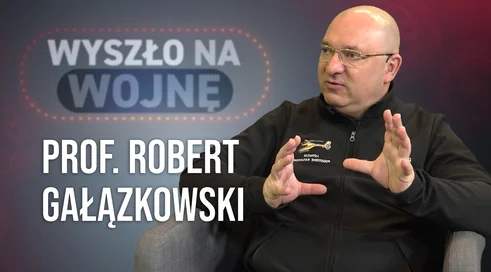
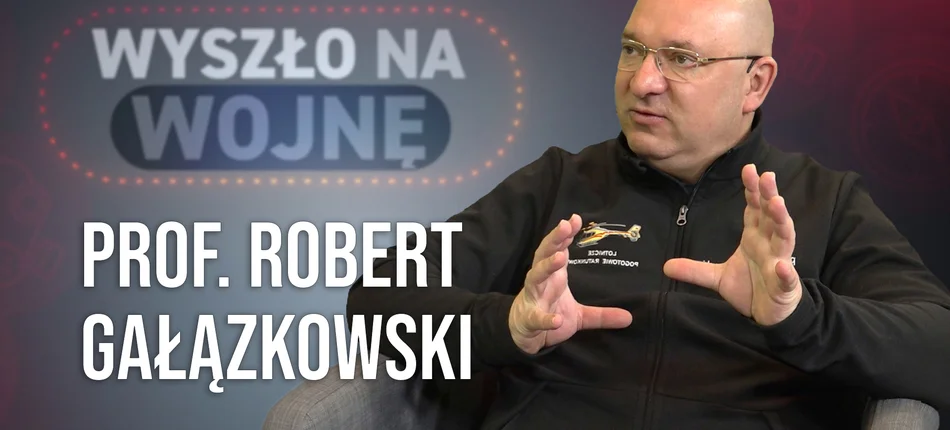
Professor Robert Galązkowski, head of the Mobile Medical Security Group of the Air Ambulance, is a guest on the program "Out to War."
#OutOfWar
War fundamentally changes approach to health care organization

Published April 15, 2024 09:00
- Something happened that was a violation of the Geneva Convention. Within the first two months, 200 rescuers, doctors, nurses who rode in ambulances to save the wounded were killed. The Russians shot at them like ducks.
- Today we have to deal with doctors with medical staff especially working in the East, who get dozens of injuries day after day. In them, the level of PTSD is so high that they can, with a patient on the table, walk out of the operating room, bang their heads on the wall a few times, come back and operate.
- We today must absolutely prepare for this, for the reason that actions on the part of the Kremlin are incalculable.
- The key is the need to train as many rescuers, nurses who function in pre-hospital rescue precisely in battlefield medicine.
- Are we today able to accept what has been standard in Israel for many years, that ambulance equipment includes helmets, bulletproof vests as standard? This has become standard in Ukraine today.
- Today the moment has come for it to be the front-line Ukrainian doctors who teach us, our doctors, how to prepare to operate on a patient who arrives dying on the table with a gunshot wound, that is, other than, for example, from an accident.
You were in charge of the Air Ambulance for 16 years, and since February you have been the head of the LPR mobile medical security group. I would like to emphasize that you were actually there from the beginning of the war in Ukraine three months after the outbreak of those hostilities. Since then you have been organizing training courses in Ukraine and Poland for medics in battlefield medicine. Tell us about your first experiences and impressions.
I had worked with Ukraine for 15 years before, so I am very familiar with the medical environment in Ukraine. I also got to know the human relations there and the hospital infrastructure. My first visit was right after the attack on Kiev, and the images I saw then horrified me. Ukraine then was at such a moment, when the theater of war, the change in the rules of conflict or war in general, very quickly showed how important it was to prepare the health care system, (because that's what we're talking about), for the consequences of warfare. Very quickly there was a shortage of drugs for anesthesia, strong painkillers, antibiotics with a very broad spectrum of action. This is what the specifics of this war turned out to be. The introduction of drones into offensive operations completely changed the nature of the wounds sustained by civilians and by soldiers. These were no longer gunshot wounds, but were largely, 80 percent, wounds from shrapnel, bullets or it was the drones. Something happened that was a violation of the Geneva Convention, namely, within the first two months, 200 rescuers, doctors, nurses, who were riding in ambulances to rescue the wounded, were killed. The Russians simply shot at them like ducks. And that's what our first talks were about, the first meeting in the MZ. There I got a request to take a systemic approach to the training of medical personnel, the pre-hospital one, in TC3, or battlefield medicine. And from our side, the response was instantaneous, as we started a series of training courses, which ended within three or four months with a number of 500 trained people. From this group, they generated a significant number of instructors, who by now are training their colleagues, colleagues all the time precisely in this specificity of operating under conditions of fire. Because this is something absolutely opposite to peacetime operations.
They are mainly women doctors, feldspersons and nurses. They come to Poland to be trained, then they themselves are already leaders of these trainings in Ukraine. Tell me, what kind of traumas do they come with?
This is terrible. Every new group is getting worse. People come who are sad, in whom such a dilemma - when will it finally end - resonates very strongly. We, in addition to teaching our Ukrainian colleagues battlefield medicine, they also have psychotherapists to teach them self-therapy in PTSD. These very classes show the trauma and drama we are dealing with. I don't know if I should talk about such things, but I will talk about them in the context of the longevity of warfare. Today we have to deal with doctors with medical personnel especially working in the east, who get dozens of wounded people day after day. In them, the level of PTSD is so high that they can, with a patient on the table, walk out of the operating room, bang their heads on the wall a few times, come back and operate. These people do not talk to their families when they return home. They are absolutely turned off. We are dealing with a huge trauma just in the medical community. The multiplicity of these cases and their extensiveness, also the drama when it comes to successfully rescuing the injured, causes a gigantic problem with medical personnel. This is what we are observing. Unfortunately, after talking to our colleagues, one can see a growing psychological problem.
When you were in Ukraine three months after the outbreak of the war, when you saw Bucha and all the horrors, you thought to yourself about us here and what we must do?
For a long time I did not allow it into my head that this could happen in Poland. But we today absolutely have to prepare for it, for the reason that actions on the part of the Kremlin are incalculable. We do not know what the nature of the potential threat may be. Whether it will be of a hybrid nature, or whether it will be like the increasing number of illegal refugee crossings in Belarus. Will it be the entry of tanks or rocket attacks? Each of these options brings with it the need to prepare appropriate procedures and adequately prepare pre-hospital infrastructure, I'm talking about emergency medical teams, but also hospital infrastructure.
Are we prepared?
Frankly, I think not. After all, the armed conflict in Ukraine is not a matter of two years ago, but it was an activity that has been going on for more than a dozen years. I would like to give such an example - at one time wounded with extensive injuries are brought to a regional hospital, to us here, where in civilian conditions, speaking of rescue, one two heavy patients should be brought to such a hospital. Therefore, we have to delocalize patients to other centers. Have the comfort of the hospital being prepared to receive 2-3 patients that it is able to take care of. And this is within the framework of mass events. And these are the conditions of peace. Now imagine in two years, day after day, 20-30 patients. Do we have adequate resources? Do we have adequately trained personnel? Do we have adequate supplies of blood and medicine?
The answer to each of these questions is no, at least for today.
The Ukrainian case showed that in the first months the European community reacted very positively in terms of the amount of blood supplied, because this blood was coming to Ukraine both from the West and from the Ukrainian community, which opened up strongly and genuinely started donating blood. On the other hand, after three months, one of our acquaintances, a cardiac surgeon at a children's hospital in Kiev, appealed, even begged, for a supply of muscle relaxant and anesthesia drugs for sedation, because the operative had completely stopped. The entire supply of drugs went to the east, where the front line and the most wounded were. They ran out for scheduled life-saving procedures.
You said about resources. I understand that you mean the number of specialists involved in, for example, battlefield medicine. We have very few of them. Well certainly not enough at a time of crisis.
Therefore, crucial today is the need to train as many rescuers, nurses who function in pre-hospital rescue precisely in battlefield medicine. Are we today able to adopt what has been standard in Israel for many years, that ambulance equipment includes helmets, bulletproof vests as standard? This has become standard in Ukraine today. Let's also note that the length of operations, more or less in the same area, already the knowledge of shooting at ambulances, destroying them. Today, for example, the challenge is to provide Ukraine with bulletproof ambulances, secured, or transporters that are able to take the wounded out of the first zone in a safe manner. Once in Ukraine, I met a doctor I trained 14 years ago. A great anesthesiologist. He, in the first months, was sent directly to the front line. The boy who was full of smiles, kindness, was sociable, became a gray wreck of a man in his thirties. He told me at the time that there were days when he would get wounded men into the trenches, who could not be evacuated to the second zone in a safe manner for 7-8 days. And out of 10 of them, after those few days, two to three survived. Imagine a doctor who defends his homeland, has to fight for the lives of his brothers fighting for a free Ukraine, and becomes helpless due to the fact that he has limited access to medicine, life-saving methods. Because what can be done in the trenches? Only emergency measures. He collides with death (he sat there for 6 months), which destroyed him.
You have a wealth of knowledge, you conduct training all the time with a team of excellent experts in battlefield medicine. Try so synthetically to point out what we should now already start preparing as a country, as a health system and as each of us.
There should be plans in every hospital for a pernamenent mass event, that is, the delivery of large numbers of injured people. Now I will say one thing that stuck in my mind, when Ukrainian wounded began to come down to Poland in the first months of the war. Many doctors didn't know how to go about it, because we have no experience at all in treating wounds (gunshot wounds, shrapnel wounds). It's completely different medicine than planned and peacetime medicine. That is, the priority is to make plans for this type of conflict, being aware of the miasma of the number of specialists. This needs to be wisely arranged. It is necessary to indicate the so-called staging of patient management. What is happening in Ukraine - frontline hospitals are frontline hospitals. There it is life-saving. Later there is provision in central Ukraine - some more finesse medicine. But in fact, the long-term consistent saving of patients is done in western Ukraine and Europe and the world. So this is the staging of the procedure. We should be aware of that, too. Because the question is where will the front line arrive, God forbid? The second thing is blood resources. The third thing is the drug resources. The fourth thing, what is very important, is the infrastructure to conduct surgical procedures even under shelling. The Russians destroyed several hundred hospitals in Ukraine. There, there was no infrastructure to save patients. They moved them to basements. I say basements not without reason. Because shouldn't there be a rapid inventory in the east of Poland of the possibility of moving a block of flats into safe levels of the building. People need to be taught that the alarm is not for fun let loose, but you need to hide and know how to behave. This is a completely different world, a completely different mechanism of life. It is also necessary to verify what are the possibilities of extending hospital facilities, organizing secondary transport, that is, from first security hospitals to the safe side. I'm going to say something that may be read as unacceptable to us, but do we have ambulances that are capable of entering this zone one and evacuating patients under fire? These are all questions that should be a big consideration today. We certainly need to review the resources of the Strategic Reserve Agency when it comes to medical equipment and medicines. Prepare mechanisms also to obtain medicines from abroad on an urgent basis, to reconstitute these resources when they are in short supply.
Does the LPR mobile medical security group you are in charge of already have any guidelines?
We, since something started happening on the Polish-Belarusian, then Ukrainian border, have defined our tasks. We are in all the security plans. Thank God the moment of verification of this in practice has not yet come. But we are constantly training, learning and preparing for different scenarios. I, being aware of what is happening, as the director of the LPR for years invested quite a lot of money emw training of all air ambulance personnel. Also in the group that is the mobile part of medical security. This was training in Israel, in the United States, showing us the mechanisms of warfare. There is also the issue of antibiotics, for example, because the Americans and Israelis have introduced the principle that each rescuer should carry a kit containing, in addition to strong painkillers, antibiotics with a very broad spectrum of action. And while in peacetime conditions this antibiotic is deployed after the diagnosis of the patient, in wartime conditions, when we have a severely injured, exposed patient, this antibiotic is already administered at the scene. Please see how battlefield medicine and its whole philosophy of the specifics of combat has changed the rules. Battlefield medicine is nothing more than safe evacuation to an area where the patient can be pre-equipped and evacuated to the first center. The war in Ukraine has shown that this is impossible in many cases. This prolonged arrival in the first zone, so it's also a question of how much we are able to approach the first zone with more advanced medicine than just giving these life-saving measures.
Tell us more so at the end of the day, what should each of us do, for example, accumulate some medicines, what to have on hand, should such a situation happen?
There is no good answer to this question. I don't want to introduce fear. Any action must be based on a rationale that is close to reality. The painkillers we buy at the pharmacy do little for wounds, because they are too weak for that. On the other hand, I think the fact that we are nevertheless a member of the European Union puts us in a completely different situation of support from the Union or from NATO when it comes to health system infrastructure or hospital resources. However, these are different mechanisms. Besides, they worked very nicely with the support of Ukraine in organizing the transportation of very seriously injured patients to Poland and beyond. So we are in a more comfortable situation in terms of resources. On the other hand, I think that the most difficult work to be done today is the large-scale training for hospital and pre-hospital personnel. From my more than two years of observation, I can see the specificity of the wounds being sustained. These were amputations, extensive wounds, extensive multi-organ injuries. It's a matter of treating burns. In Poland, we had centers for this, but of course they are not prepared for large-scale treatment. But this shows the directions in which we need to go. I, today, dare to put forward such a thesis that Poland supported the Ukrainian side in terms of teaching the Ukrainian doctors there, for example, injuries related to explosions and problems with the auditory system. We taught certain procedures. There were several specialties in which Ukrainians did not have enough experience. It seems to me that today the moment has come for the front-line Ukrainian doctors to teach us, our doctors, how to prepare to operate on a patient who comes dying to the table, an injured patient, with a gunshot wound that is different from, for example, from an accident.
Thank you for the interview. Let's hope we never have to find out to what extent we are prepared for such a crisis situation.