For some time, the Minister of Health and the Prime Minister, as well as some other representatives of the government, have been boasting in the media that the current government has greatly improved the situation of public health care. This is evidenced by greater than ever before - and still increasing - outlays on treatment. Reportedly, the law providing for the appropriate level of expenditure (in relation to GDP two years ago) is being implemented even in advance. Let us recall that it predicts that these expenditures will reach 6% of GDP in 2023 (GDP from 2021) and in 2027 - 7% (from 2025). Since an increase in expenditure on public health care has been demanded for years, and only now is it implemented, it best proves - according to the government - that health care is a priority for this government.
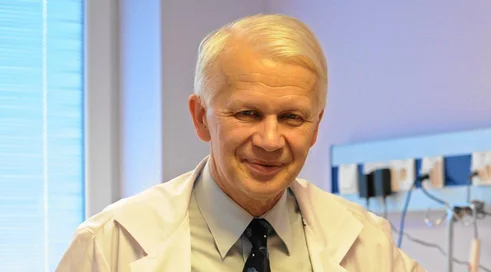
Krzysztof Bukiel
Klawo as hell - author's current commentary

Published Dec. 7, 2022 08:31
This optimistic and positive message, however, is disturbed by another message coming from the person - probably the most important in the ruling camp - from the PiS president. At virtually all meetings with voters, held for several months, the PiS president states that public health care in Poland still does not function well, queues to doctors have not decreased at all (objective research shows that they have increased), and patients complain about "service health” just as they complained before.
What follows from the summary of these opinions.
The amount of expenditure on public health care is not an indicator of its efficiency and functionality. In other words: it is not about spending a lot, but about ensuring that patients who need medical help receive it in a timely manner and of the right quality. OZZL has always paid attention to this. Therefore, the union has always emphasized that an appropriate system of public health protection is necessary, and expenditures are only an element of this system, which must be adjusted to other elements. There can be a good system with relatively small expenditures and a bad system with large expenditures. If there were moments when an increase in expenditure was our basic postulate, it resulted from a certain tactic of dealing with the government. To put it simply - we decided that the rulers would not understand other postulates than the simplest one: more money, they would also not agree to "systemic" postulates other than their ideas, which boil down to increasing centralism and statism in public health care.
The current situation, when expenditure on public health care has increased and its condition has not improved, proves that the method of "reforming" health care adopted by the government is inappropriate. It is true that the PiS president does not notice this and puts the whole blame for the government's failures in this area on doctors who, in his opinion, earn too much, do not think about patients only about "business", etc., but it is hardly surprising that the head of the ruling party takes such an attitude . This statist direction of changes in health care is his personal idea and his idée fixe. For years, he was probably the only important politician who opposed the introduction of sickness funds and market elements to health care, and now - when he was able to realize his vision - it is not easy to admit a mistake. The more so that "in the meantime" a large group of experts and officials appeared (headed by the Minister of Health), who confirmed him in the rightness of taking this statist direction (experts and ministers also have to make a living).
By the way, this is not the first case in history when failures in introducing a centrally and manually controlled economy (health care is also an economic activity) were justified by the actions of other factors: saboteurs, speculators, small capitalists, economic sanctions of capitalist states, etc. it took many years for the rulers to admit that the socialist economy is not able to meet social expectations.
At what stage of the road to rationality in public health care are we (as a state)? Very far from the target, I'm afraid. Everyone found their place in this "mess": the rulers indicated who was to blame for the poor functioning of health care, patients found "shortcuts" to deficit services through acquaintances or private surgeries, doctors - taking advantage of their shortage - learned to negotiate appropriate terms of the contract, other medical workers have a statutory guarantee of minimum wages, to which they can make extra money by working overtime and on-call duty, hospital directors have found a way to supplement funds from government and local government subsidies or from sponsors, and ... somehow it goes on. Even the opposition is happy because they have something to criticize the government for and they have something to promise potential patients and healthcare professionals.
Krzysztof Bukiel December 5, 2022