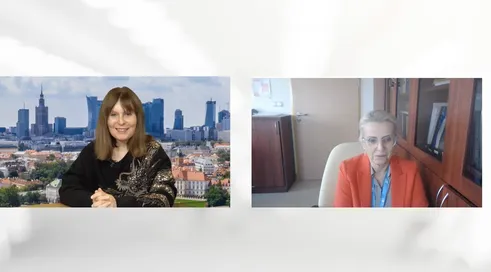
In August 2024, during the Children's and Adolescent Health Congress, I met an extraordinary family: twins Kacper and Karol, who suffer from Friedreich's Ataxia, their older brother, and their mother Teresa - a woman who can boldly be called a superhero. Their story is moving and inspiring. For although they struggle with a disease whose name sounds foreign to many, their daily lives are filled with an abundance of love, strength and mutual help. In rare diseases, often the biggest challenge is... helplessness. No diagnosis, no medication, no hope. But breakthroughs do happen. Do you remember SMA? It used to be that a diagnosis meant a verdict for the whole family. Today, Polish patients have access to modern treatment and one of the best drug programs in the world. The story of SMA is uplifting and worth recalling whenever treatment options emerge in rare diseases - as they do now in Friedreich's ataxia. We talk about the diagnostic possibilities and hopes for treatment of Friedreich's ataxia with Prof. Konrad Rejdak from the Department of Neurology at the Medical University of Lublin, a member of the Program Council of the European Academy of Neurology.
Living with a rare disease. Hope for patients with Friedreich's ataxia

Published April 17, 2025 06:33
Fot. MedExpress TV
Friedreich's ataxia - what is this disease? What are its causes and symptoms?
Prof. Konrad Rejdak: Friedreich's ataxia is a very rare disease with a genetic basis. It manifests itself with impaired motor coordination, as well as limb paresis and impaired deep sensation. It can also cause disorders of pancreatic secretory function and cardiac complications, so the risk of mortality here is much higher. Typically, the disease lasts 10 to 20 years after diagnosis and significantly shortens life.
The disease equally affects girls and boys, most often between the ages of 10 and 15. It progresses slowly, and the first symptom is sometimes gait disturbance. Children begin to deviate in dexterity from their peers, such as in P.E. classes. They are then often taken to an orthopedist, as abnormalities of the skeleton and feet appear, which can steer the diagnosis in a different direction.
For years, Friedreich's ataxia was considered an incurable disease, but opportunities to modify its course have emerged.
To talk about treatment at all, diagnosis is needed. What is the patient's path to diagnosis?
Prof. Konrad Rejdak: Unfortunately, there is a problem with the availability of genetic testing. Although we have excellent specialists and good laboratories, there is not enough funding for routine diagnosis of such diseases. The system assumes that a patient with a suspected disease will be referred to a genetic clinic - but the wait there is very long. Ideally, such tests could be performed directly in neurology clinics and departments. This is theoretically possible, but funding remains a problem.
The bottleneck is the implementation of orders. If all doctors referred patients for genetic testing, the system would become clogged. And let's remember that congenital ataxias is a whole group of diseases with different causes - so there is a need for broad diagnostics, including different genetic variants.
Some said that since there is no treatment, the diagnosis doesn't change anything. Today, however, the situation is different. Besides, the problem of our system is also that basic tests are duplicated to justify hospitalization. This generates costs and doesn't contribute anything - the key is the genetic test.
The inclusion of such an important test in the reimbursement package would make a difference to patients - they could get a diagnosis faster and start the right treatment. With a diagnosis, they are no longer wandering around the system, and are not subjected to further unnecessary tests. This saves both them and the system.
What can a patient count on in Poland and around the world after diagnosis?
Prof. Konrad Rejdak: Once the diagnosis is made, the patient can expect appropriate care. Cardiovascular monitoring is key - many patients have hypertrophic cardiomyopathy, which is a serious risk.
For the patient, the diagnosis is also emotionally important. The patient begins to accept that he has a specific disease. He doesn't keep looking for the cause because everyone is spreading their arms, not knowing what's wrong with him. This is a drama for many. Diagnosis also makes medical management easier. We can't yet cure Friedreich's ataxia patients, but a drug has emerged that can slow the course of the disease.
How does the drug work? How does it change the patient's perspective?
Prof. Konrad Rejdak: The new drug - which is not yet reimbursed - has already been approved and registered. The process of evaluating the appropriateness of its reimbursement is currently underway. For some time, it was available as part of rescue access to therapy (RDTL), but due to the ongoing evaluation - it is currently not possible to include new patients in this way.
Data so far show that the drug slows the progression of the disease. This is a huge breakthrough - because previously patients had no pharmacological option to influence the course of the disease. Let's remember that this will still be a complex management. But there is great hope for these patients. Especially when the disease is detected early and its disorders resulting from nerve cell dysfunction can be counteracted.
How to evaluate the results of treatment?
Prof. Konrad Rejdak: The mFARS scale is used to assess the functioning of patients with Friedreich's ataxia, and benefits can be demonstrated with it. It allows us to differentiate between reversal of symptoms and stopping the progression of the disease. In this case, we are talking more about stopping the rate of the disease. But in some patients we also see functional improvement. It already depends on age and group, on what stage we start treatment. In children, the outcome will be better. This translates into quality of life for patients.
How does the disease affect the life of the patient and his family?
Prof. Konrad Rejdak: I have two sisters, now grown up, under my care, who are taken care of by my mother. I guess that this is a drama at the family level. And yet they are cheerful people with a great distance from their situation. Their attitude is encouraging. We are trying to make them feel that we will do everything we can to halt the progression of the disease. It will also be a big relief for the caregivers, because they too will feel that there is a chance to stop the disease.