Diagnostic tools to select breast cancer patients who can avoid chemotherapy in the treatment process and drugs to reduce the risk of recurrence of this cancer were discussed at the Breast Cancer Forum on November 28.
Health Meeting
Breast Cancer Forum

Published Dec. 10, 2024 09:15
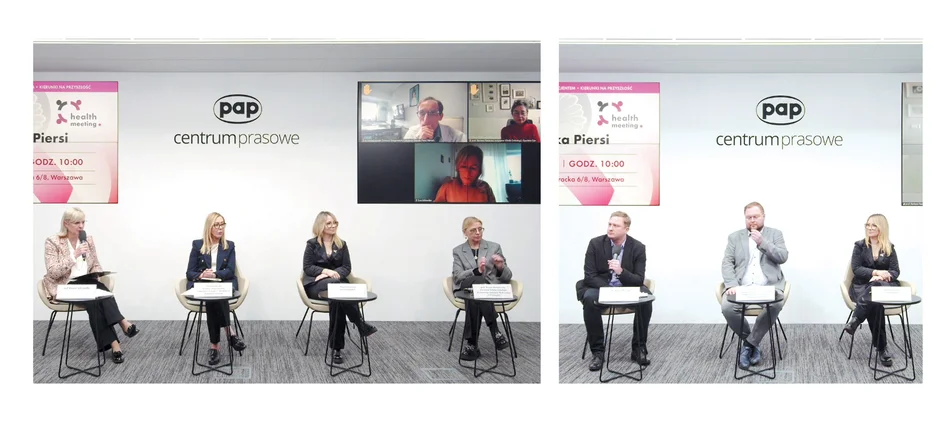
Participants in the Breast Cancer Forum discussed improving therapeutic processes based on personalized medicine and adapting systemic solutions to changing therapeutic paradigms.
Without genetic diagnosis, it is difficult to design tailor-made treatment
Professor Renata Duchnowska, head of the Department of Oncology at the Military Medical Institute in Warsaw, pointed out the importance of multigene testing to help select the right treatment. Previously, treatment selection in hormone-dependent (luminal) HER2-negative breast cancer was based on clinicopathological factors, which did not always answer the question of how to select complementary therapy. - Multigene tests are not new, as they have been on the international market for many years. Unfortunately, in Poland they are still not reimbursed. There are already quite a few of them: Oncotype DX and MammaPrint, Breast Cancer Index or EndoPredict. All of them have prognostic value and tell you who to treat. Among them, Oncotype DX stands out, which is the only one that tells you how to treat- she stressed. She added that the effectiveness of Oncotype DX has been confirmed in two large clinical trials: TAILORx in patients without involved axillary lymph nodes and RxPONDER in women with involved 1-3 axillary lymph nodes.
Michal Jarzab, PhD, of the Center for Diagnosis and Treatment of Breast Diseases at the Maria Sklodowska-Curie National Cancer Institute - National Research Institute in Gliwice, Poland, spoke about the results of the PONDx study, published in the scientific journal Contemporary Oncology in October, which showed the impact of using the Oncotype DX multigene test on clinical decision-making. It was found to reduce the use of chemotherapy in patients with early HER2-negative/HR-positive breast cancer without lymph node involvement. After the Oncotype DX test, the reduction in chemotherapy affected 40% of patients. In contrast, its use after the test, despite a previous negative decision, affected 10% of patients. - The use of the test made it possible to conduct treatment in accordance with what US algorithms and the ESMO (European Society for Medical Oncology) algorithm say. Prior to the test, the doctor and patient would make a decision regarding the use of chemotherapy. Then we confronted the patient and the doctor with the result of the test. And we found that the number of unnecessarily used chemotherapies decreased. There was also a group of patients in whom, based on classical factors, chemotherapy would not have been applied, and after confronting the test result, chemotherapy was applied," he pointed out.
The use of tests has also made it possible to standardize therapeutic management, because previously it happened that one doctor recommended chemotherapy and another did not. And this affects the level of patients' trust in their doctors.
A tool for solving decision-making dilemmas
Professor Barbara Radecka, head of the Department of Oncology at the Prof. Tadeusz Koszarowski Oncology Center in Opole, pointed out that until now, when choosing a treatment method, clinical-pathologic factors were used as a guide, and on the basis of these, three prognostic groups were defined: patients with a high, intermediate and low risk of recurrence. Proceedings were adjusted according to this division. - However, in the group of intermediate-risk patients, which I call the "gray zone," the guidelines were ambiguous. They said that perhaps the inclusion of chemotherapy would provide additional benefit. Multigene testing helped clarify the position in this group. (...) We know in which cohort of patients these tests should be reimbursed. And their use will reduce the number of chemotherapies performed. And doctors will be able to confidently abandon six months of toxic treatment, which can have permanent consequences, such as neuropathy," she argued.
Professor Renata Duchnowska stressed that the tests are already well established in international recommendations, both American and European.
- I emphasize the recommendations of the National Cancer Comprehensive Cancer Network (NCCN) Polish edition, because they will guide reimbursement for the Ministry of Health. We have been working on a new version of the recommendations for Poland, and there it emphasizes the role of Oncotype DX in all algorithms both before and after menopause. And we should follow these guidelines in clinical practice," she recommended.
Benefits for the patient
Dr. Michal Jarzab pointed out that a doctor who offers non-refundable solutions to patients exposes himself to a number of ethical concerns. - And avoiding chemotherapy means eliminating the damage it does to the bone marrow, neurotoxicity. These are long-term consequences, often resulting in inability to work. 70-80% of breast cancer patients who have follow-up chemotherapy are unable to work," he calculated. - For me, the most important factor is the trust factor between doctor and patient, because a decision made without a test is less reliable, he added.
Magda Cardinal, president of the patient organization OmeaLife, added that patients fear destruction from treatment toxicity, hair loss, poor appearance and well-being. - Educated patients will know when it makes sense to take the test. So there should be no fear of such a large group becoming a cost challenge for the system. And in modern personalized medicine, the patient should have tailored therapy and and maintain the best possible quality of life," she pointed out.
Clinicians stressed that up to 80% of patients with early luminal HER2-negative breast cancer do not require chemotherapy.
Ewa Milewska of the Health Ministry's Treatment Department said the ministry is open to requests from the clinical and patient communities, appreciating the role of personalized medicine. And when making decisions, it also takes into account the impact on the payer's budget.
Iwona Kasprzak, director of the Drug Management Department of the National Health Fund, acknowledged that the problem of the availability of multigene tests is important and will certainly have to be introduced into the basket of guaranteed services.
Professor Barbara Radecka acknowledged that chemotherapy does not represent a large cost, but if we add 16 hospital administrations and reimbursement for antiemetics, the cost-effectiveness of the technology is to be proven.
Alignment of system solutions with therapeutic paradigms
Prof. Barbara Radecka pointed out that early breast cancer is treated with the intention of a cure. - In early disease, we use radical treatment with the intention of a cure, which means that the disease will not return and the patient will not die from it, she explained.
Dr. Agnieszka Jagiello-Gruszfeld of the Mazovian Oncology Hospital in Warsaw pointed out that patients with early hormone-dependent breast cancer are a diverse group. Patients at high risk of recurrence should receive chemotherapy and hormone therapy and, according to current European standards, be referred for complementary treatment with CDK4/6 inhibitors - We have two drugs registered that have shown efficacy in prolonging the time to the appearance of recurrence or in avoiding it abemacyclib and ribocyclib. Abemacyclib is for patients at high risk of recurrence and should be used for 2 years, while ribocyclib has shown efficacy in the intermediate and high risk groups. Unfortunately, we do not have reimbursement for CDK4/6 inhibitors in this indication," she lamented.
- We hope that the reimbursement process will be completed quickly and we will be able to use these drugs at an early stage of the disease," Prof. Barbara Radecka noted.
Cyclins are substances that block molecules that direct the cell cycle. Drugs of this family inhibit the division of cancer cells and, consequently, cause their death.
- This is an excellent therapy that is non-toxic, oral, and can be used at home. With it, we are able to push back recurrences, and we should do so," she added.
Magda Cardinal stressed that women who are diagnosed with breast cancer early are the ones doing preventive examinations. And they are the ones who are denied treatment to avoid recurrence. The cost of the drug through the hospital pharmacy is about PLN 6,500 per month for 2 years. - We cannot rob these women of their future. And relapse and re-treatment will cost more, because the same drugs in a relapse situation are already used without time limits," she appealed.
Mateusz Oczkowski, deputy director of the Department of Drug Policy and Pharmacy at the Ministry of Health, noted that almost all therapies for breast cancer are available in Poland.
He reported that reimbursement proceedings are currently underway for abemaciclib in the indication for the treatment of HR+/HER2- early breast cancer in patients at high risk of recurrence. The company received a negative decision a year ago and has taken a second approach. The application is at the AOTMiT. The manufacturer of the second drug has just registered a similar indication in Europe.

Topics
Forum Raka Piersi