What is kinesiotaping, what are the indications and will it replace a facelift? - says Magdalena Dabrowska-Galas, MD, head of the Department of Kinesiotherapy and Special Methods at the Department of Physiotherapy of the Faculty of Health Sciences in Katowice of the Medical University of Silesia in Katowice.
Slices for health

Published April 27, 2023 12:51
Until recently, we usually saw colored patches on athletes' bodies. Terms kinesiotaping is very popular. Although as a physiotherapeutic method was developed by Japanese chiropractor Kenzo Kase as early as the 1970s, but was not really popularized until after the 2008 Beijing Olympics. It was difficult to convince people of the effectiveness of this method?
Over the past few decades, kinesiotaping has become a popular method used in sports and physiotherapy, among other fields. The use of kinesiotaping during the Olympic Games has sparked interest not only among athletes and patients. Increasingly, we are seeing athletes with a colorful application of a "patch" that, thanks to its properties, does not restrict movement, but allows full mobility to be maintained in the joint.
Nowadays you can even buy guides like: taping for everyone. Is it really for everyone?
Applying the patch looks very simple, but it is not recommended that patients perform this procedure on their own. Expecting the results of applied kinesiotaping, the application must be correct. For this, knowledge of biomechanics, anatomy is needed to choose the right application technique, location and degree of tension of the patch. Incorrect application can cause the opposite of the intended effect.
What is the therapeutic significance of kinesiotaping? What are the indications for kinesiotaping?
The applied patches do not have any drug in them. Thanks to the selected application technique and elastic properties, the patches stimulate the appropriate receptors, pulling the skin layer away from the deeper lying tissues, thus improving blood and lymph flow. Thanks to this, they can affect, among other things, muscle relaxation, reduction of pain or swelling. Kinesiotaping is used to relax muscles, reduce pain, improve fascial mobility, increase tissue elasticity. The method effectively assists in reducing swelling or stabilizing a joint. Appropriate patching techniques are also used successfully in pediatric, neurological, gynecological, dental and cosmetology patients. However, it should be emphasized that kinesiotaping is used as an adjunctive method of the therapeutic process, as confirmed by the results of meta-analyses in recent years.
It's understandable when we see colorful patches on the backs or legs of tennis players or runners. But they are also used by people for whom it has no health-promoting (injury treatment) significance. Why, or does it have a rejuvenating effect?
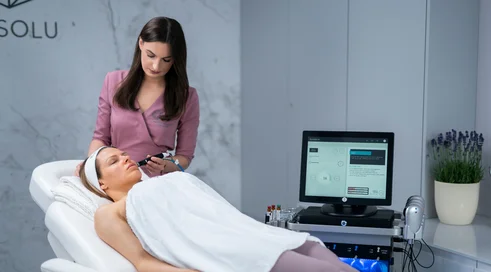
Increasingly, kinesiotaping is being used in cosmetology. Anti-aging type application is used supportively to prevent wrinkles in the eye area, as well as to prevent skin sagging in the chin area, improves microcirculation and skin elasticity. This type of treatment is usually applied for about 30 minutes and precedes the application of other specific cosmetic agents.
Can face taping, a phenomenon of recent years, be a way to get rid of an emerging wrinkle? Will taping replace Botox and the classic facelift?
In this case, too, kinesiotaping is used as an adjunctive method, complementing other treatments in the field of cosmetology. Regularly applied patches can prolong the effect of these treatments, giving a sense of shallowing wrinkles by relaxing facial muscles, increasing skin elasticity, and thus lifting effect, but aesthetic medicine treatments will not replace them.
Can we stimulate muscle memory and re-learn how to work the tapes correctly on the face?
The skin on the face is delicate, besides, the principle of the effect on the facial muscles is the same as for other muscles, that is, depending on the application technique, the patches can produce a toning effect or muscle activation. Here, too, we can speak of a supportive effect. The application of the patch alone will not be a sufficient stimulator for muscle learning and is not the main point of therapy.
What safety rules should apply when using taping? How do taping patches differ from normal patches?
They differ in color, which generally does not affect its effect on the patient's body. Kinesiataping patches are made of cotton, they are flexible, permeable to air.
In terms of safety, it is important to know the indications and contraindications for kinesiotaping, as well as the principles and techniques of taping. The application of the patch should be preceded by a history, examination of the tension of the soft tissues or joint, and clinical inference taking into account the therapeutic process and biomechanics. It is extremely rare for allergic reactions to the adhesive to occur after patch application, but it is important to keep this in mind. If an adverse reaction occurs, the patch should be removed from the skin immediately.
How long can the patches be kept on the body?
The patches are waterproof and do not interfere with daily activities. On average, the application usually stays on the skin for several days, sometimes longer. In cosmetology, kinesiotaping is used as a preparation of tissues for treatment with specific cosmetic agents.
Source: SUM