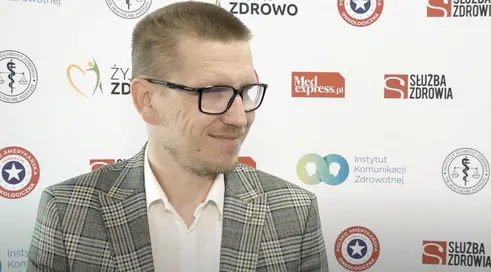
- I am safe. I live and act as if I don't have this disease," says Wojciech Mościbrodzki, a patient with hemophilia A.
Today, hemophilia is not a sentence - patient story

Published Aug. 7, 2024 07:24
Medexpress: Please give our viewers an idea of what life is like for the average hemophilia patient in Poland. How does this disease affect daily functioning, what difficulties and challenges does it involve?
Wojciech Mościbrodzki: Hemophilia is a genetically determined clotting diathesis. That is, to put it simply, my blood has very big problems with clot formation. The danger is, of course, all external wounds, but also internal bleeding, primarily to the joints. The joint fills with blood, like a balloon, until the blood pressure is not balanced by the joint envelope. This is associated with further complications, because when the body dissolves this clot, it also damages the joint cartilage. Thus, hemophilia is usually characterized by extensive damage to the joints, compounded over time. Treatment of hemophilia has so far relied on supplementation of the missing clotting factor. Supplementation is accomplished through intravenous injections. The factor is administered after the onset of bleeding. At the moment, a new generation of drugs completely changes the situation of hemophiliacs, because it allows prophylaxis, that is, administration of the drug without waiting until bleeding occurs. This de facto prevents all kinds of dangerous bleeding. Classic therapy required us to be able to insert ourselves into a vein, which was sometimes a problem, if only when a joint in the hand whose dexterity is needed to give ourselves an injection was damaged.
Another problem is the half-life of the supplemented clotting factor - it is very short. To act on existing bleeding, it had to be administered as soon as possible and then repeated intravenous infusions, usually on a schedule of every 8 or 12 hours. This raised certain difficulties - for example, how to apply such treatment when we are away, traveling and don't have access to the drug. This posed a very high risk. Therefore, the life of a hemophiliac, especially of my generation, was sedentary. It was said that the typical profession for a hemophiliac was a watchmaker. Very many patients of my generation finished their education early and decided to pursue a career as a craftsman with a sedentary, quiet lifestyle. Thanks to new drugs, the situation has changed as if by magic. First, because we don't have to react the moment something happens, we just prevent it. I give myself the drug subcutaneously (which is an extremely simplified procedure) once every two weeks. As my attending doctor told me, I don't actually have hemophilia at the moment. My clotting levels are at the level of a healthy person. The only thing I'm dealing with at the moment is the aftermath of being born too early and so many years passed before the drug came along.
Medexpress: That is, the Lord has been treated with both classical therapy and, for the past 5 years, innovative therapy....
Wojciech Mościbrodzki: Yes, I participated in a clinical trial. And thanks to this study, I understood what a gigantic breakthrough in treatment this is.
Medexpress: You underwent wisdom teeth extractions twice - once for the classic treatment and once for the new one. What was that like?
Wojciech Mościbrodzki: For a hemophiliac, tooth extraction is a life-threatening condition. Because it is significant bleeding. So before the extraction took place, I had to be prepared, i.e. take a preparation before and after the procedure itself. Here there is always a problem, because the moment the bleeding has stopped, there is an argument not to give the next dose anymore, because it is a foreign protein, however, it is not inert to the body. But if we stop factor supplementation too early, there will be a recurrence of bleeding. The trick is to decide at what point to stop. My specific example - after having my "eight" pulled out in a very good hospital, by really great specialists, the bleeding continued for a month. For a month I agonized, had to go there, when changing the dressing, the clot was disturbed, etc. On the other hand, my second "eight" was already removed when I was treated with emicizumab. It looked like I made an appointment with the dentist for a certain day, without preparing at all. The tooth was extracted and there was not even a particularly large swelling. Three days later I was already lecturing at the university. Heaven and earth.
Medexpress: How does modern therapy change approaches to life? How does it affect what a person can and cannot do? How has entering a clinical trial changed your capabilities, your activities?
Wojciech Mościbrodzki: I am a peculiar case, for the reason that I had already led a fairly active life. At the same time, being active with hemophilia also means constantly waiting for something bad to happen. Delivery hemorrhages occur spontaneously, for no apparent reason. In the morning I wake up and feel that there is a stroke in the joint. This has happened many times. This obviously limits the prospects of personal and professional life. For a while I was a manager, a director in a company. But how to explain to the employer that you never know if I will come to work the next day. And if there is a stroke, rehabilitation and recovery can take two or three weeks. For the company, this is a very heavy burden. When I later gave up such a life for an academic career, there were also problems, like canceling classes. Students are never sure if I will make it to class. This is a life with a much lower level of activity than that of a manager, but there is still the sword of Damocles hanging over me all the time - maybe I won't be able to get up tomorrow, maybe I won't be able to teach a class, maybe I'll feel unwell during a lecture. And then what? So life is filled with stress and a sense of constant danger. On the other hand, how my situation has been changed by emicizumab is really something unbelievable for a hemophiliac. The danger that something could happen to me is gone. I am under the protection of the drug, and as a result, I live a normal life and lead a very active life. At the moment I am working at four universities. I move around virtually without any problems. I came to this recording by public transportation, which is usually impossible for the average hemophiliac. We actually only move around in cars, because at any moment it can happen that in public transportation someone pushes us, someone trips, the driver brakes suddenly and a gigantic problem begins. Once again, I emphasize that the old methods of treatment required intervention, that is, administration of the drug after the event. Only how to get home, how to move if the bleeding continues and, for example, affects the lower extremities? It is impossible to move around. And with the new drug I have no such problems. I'm safe, I'm alive and I'm acting as if I don't have this hemophilia. Of course, I face some consequences of the previous lack of innovative treatment. I have damaged joints, so I limp. It's hard to call me a thin person, for the reason that a hemophiliac can't run, ride a bicycle, etc. On the other hand, if this drug was administered from a young age, a person could exercise and this problem would not exist. I know hemophiliacs, younger than me, who have learned to ride a bicycle, take trips, which of course also affects their comfort in life, but also the fact that problems related to obesity and its consequences, such as diabetes, do not appear. I once read a story about children with diabetes who were in a ketone coma. I think it was somewhere in Japan. They were actually already doomed to die. Then the doctors gave them a then new drug -insulin. The children began to wake up. This is the same kind of breakthrough for hemophiliacs.
Medexpress: What systemic changes in the treatment of adults with hemophilia does the patient community in Poland expect?
Wojciech Mościbrodzki: I don't know if I can speak for the community, but the implementation of emicizumab therapy is a lifesaver, allowing us to live a long healthy life, but it's also a reduction in the cost of treating other diseases, because with this drug we remain healthy people. If I were to talk to a goldfish, I would say: goldfish, new preventive therapies like emicizumab for everyone and as soon as possible. Because it gives us life. Literally. Not a "better life," but life.
Medexpress: What would you say to other people who are struggling with this disease, but perhaps don't have as much knowledge, as broad a perspective on it?
Wojciech Mościbrodzki: That' s an interesting question. I think hemophilia is a tough disease, one that we struggle with all our lives. But on this "wheel of fortune of life" you could draw worse. I've known people suffering from more difficult diseases, and I've known those who were born too early, never had to deal with new therapies, and died. To those who are hemophiliacs today I can say: hemophilia is not a sentence. Thanks to a breakthrough in science, you can realize everything you have dreamed of. You can live, develop, work, travel. It is possible, it is within reach.
Topics
hemofilia