Outlays on health care will amount to a minimum of PLN 225.2 billion in 2025, or PLN 16.6 billion more than the current year's spending plan, according to the latest edition of the Health Care Financing Monitor, which was presented Wednesday by the Federation of Polish Enterprises.
Polish paradox: Health expenditures increase and decrease at the same time

Published Aug. 14, 2024 16:37

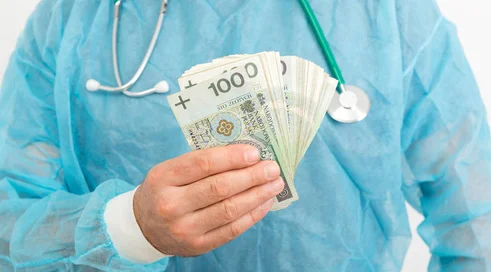
Fot. Getty Images/iStockphoto
As emphasized by Lukasz Kozlowski, chief economist of FPP, these estimates - based on the latest data and macroeconomic forecasts - indicate that we will reach 6.6 percent of GDP according to the statutory methodology (the minimum level assumed in the law is 6.5 percent), which means that year-on-year we will see a decline in outlays, both according to the statutory methodology (n-2) and as a real percentage of GDP (here the change should not be large, we can talk about stagnation).
In 2025, outlays on health care must amount to no less than PLN 221.7 billion. Meanwhile, the level of spending resulting from the submitted plans can be estimated at around PLN 225.2 billion. Thus, the real percentage of GDP on health will reach 5.65 percent of GDP - about the same amount we will spend this year. - The declarations of the Finance Ministry clearly indicate that at the stage of designing the NFZ financial plan and working on the budget law, public institutions will assume spending at a level close to the minimum specified in the law of 7 percent of GDP for health," stressed Lukasz Kozlowski. How will this freezing of the level of outlays and the implementation of the "minimum plan" translate into the availability of health services?
The FPP has analyzed the annual reports of the National Health Insurance Fund on realized benefits by scope. Experts point out that the nominal financing of benefits realized under the NFZ has increased by more than 130 percent since 2016. - Even after accounting for the effects of inflation, this means an increase of more than 50 percent in real terms, and 16 percent when discounted by the dynamics of nominal GDP growth. - Kozlowski emphasized. At the same time, the number of services performed in the main categories covered by the analysis increased by only 6.3 percent. Experts consider the situation in AOS, where the number of services increased by 0.4 percent over the period (but funding, in real terms, taking into account changes in GDP, decreased by as much as 25 percent), to be particularly worrying.
The problem, said Lukasz Kozlowski, is that the entire increase in outlays (nominal) is currently being used to finance cost increases (including labor costs), while there is no way, at least for now, to generate more services with it, which would improve accessibility. Experts, at least for the moment, do not see the potential for such a change in the draft amendment to the Law on Health Services, presented last week by the Ministry of Health, which is intended to become the foundation of systemic reforms (although it focuses on hospital care, the Health Minister has announced that part of the changes will be an inversion of the pyramid of benefits, i.e. shifting a significant portion of them to outpatient care).