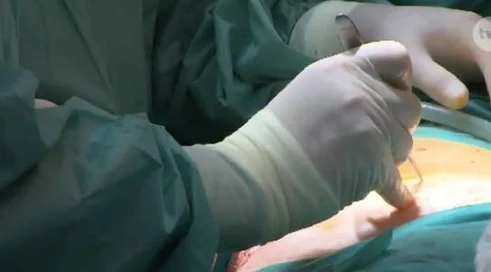
A new method of treating osteoarthrosis (OA) developed at Jagiellonian University is now past Phase II clinical trials. It is a rarity in Poland for a medical technology developed in academia to be at such a high level of implementation. The therapy is based on the use of mesenchymal stem cells (MSCs), which, when implanted into diseased joints, significantly reduce the pain associated with OA, as well as stimulate the regeneration process of damaged tissues.
New therapy for osteoarthritis developed at UJ

Published July 21, 2025 11:11

The therapy developed at the Jagiellonian University is the result of several years of work by a scientific team led by Prof. Ewa Zuba-Surma, PhD, of the Department of Cell Biology, Faculty of Biochemistry, Biophysics and Biotechnology at the Jagiellonian University, and several years of cooperation with Galen-Ortopedia sp. z o.o. in Bierun, where Phase I and II clinical trials of the developed drug were conducted.
A full treatment process has been developed
The new therapy is comprehensive in nature. It includes a method of preparing a preparation composed of mesenchymal stem cells (MSCs - from Mesenchymal Stem Cells). They are isolated from the patient's adipose tissue and then cultured and multiplied under strictly controlled conditions. The entire technology developed further includes the appropriate preparation of the patient to receive the drug, as well as the use of a specific formulation of MSCs cells and the method of administering the medicinal product to the affected joint.
The developed therapy functions under the name MesoCellA-Ortho and is designed to treat osteoarthrosis of the joints, including the knee. Phase III clinical trials are still needed for the drug to reach the market, to which the UJ would like to invite a MedTech partner. A search is currently underway for a company or investor to jointly carry out the technology transfer and commercialization process.
What does MesoCellA-Ortho therapy consist of?
In organisms, MSCs stem cells are present in many tissues, primarily in fat tissue and bone marrow. They have special properties - under the influence of various stimuli they transform (differentiate) into cells of various tissues, including bone, cartilage or fat. In addition, they have significant secretory potential, so they play an important and useful role in regulating many processes related to tissue regeneration, including the formation of blood vessels, as well as inhibiting and extinguishing inflammation.
- Many scientific studies prove that stem cells, given at the site of tissue damage, stimulate the regeneration of these tissues. When working on our new therapy, we based our work on this phenomenon. In the case of our therapy, we start by harvesting the patient's fat tissue, or liposuction. Stem cells are isolated from this tissue, and then, according to a method we have developed, they are cultured and multiplied to obtain a sufficiently large number of them. It takes about two weeks to culture MSCs in a laboratory, which is a pharmaceutical plant. During this time, the patient, through physiotherapy exercises, is prepared to take the drug in the best possible way. The idea is that the meticulously prepared preparation will work fully effectively," explains Prof. Ewa Zuba-Surma, the leader of the team that developed the MesoCellA-Ortho drug.
MesoCellA-Ortho belongs to the category of innovative personalized therapies, whose mode of action is based on natural biological mechanisms, where the patient's own cells are the basis. In practice, it is an autologous transplantation of cells, which potentially increases the effectiveness of the treatment and at the same time reduces the risk of side effects or complications related to the risk of rejection of the transplant.
- Every drug that is manufactured individually for a patient is subject to a strict panel of quality control tests and must have its own certificate, confirming its quality and applicability. These control procedures are strictly defined by regulations and apply to all drug manufacturers at every stage of their production. In the case of the therapy we have developed, it is crucial that we have developed the drug in accordance with the requirements of Polish and European law. This significantly increases the likelihood that in the future it will obtain approvals from agencies certifying new drugs, such as the EMA or the FDA, for its market introduction," noted Dr. Anna Labędź-Masłowska of the Department of Biochemistry, Biophysics and Biotechnology at the Jagiellonian University, a member of the scientific team and co-developer of the MesoCellA-Ortho drug.
Satisfactory phase I and II clinical trials
Both phases of the clinical trials were carried out in cooperation with Galen-Ortopedia Ltd. in Bierun. Nearly 200 patients affected by osteoarthrosis took part in the study, which was administered the new drug to the damaged knee joint.
- During the clinical trial, we had strictly defined endpoints. These concerned confirmation of the safety and efficacy of the therapy. The safety of the drug was clearly demonstrated, with no side effects observed. Efficacy was confirmed by meticulously measuring the comfort of patients undergoing therapy. It should be noted that comfort was analyzed using specific scales used in orthopedics, so the study was based on hard data and not just subjective opinions of patients," adds Prof. Ewa Zuba-Surma.
In efficacy studies, very optimistic results were obtained. Patients showed a reduction in osteoarthrosis-induced pain, which translated favorably into parameters determining quality of life (using, among other things, the SF-36 form defined for clinical trials). In addition, patients regained mobility.
- Patients undergoing therapy confirmed that they were more able to perform motor activities that they had previously found difficult or impossible to perform. Importantly, during the Phase II clinical trials, we also assessed the condition and quality of cartilage within the knee joints using magnetic resonance imaging. In these studies, we confirmed that there were beneficial changes in the structure of the subchondral layer of bone - the spongy bone - after the drug. We associate the reduction of pain in patients with an overall improvement in the quality and structure of tissues affected by osteoarthrosis, and this may mean that the new drug acts directly on the cause of the disease, i.e. degeneration and tissue loss, which in the medical world is extremely valuable," says prof. Krzysztof Ficek, MD, President of Galen-Ortopedia sp. z o.o. in Bierun and co-developer of the MesoCellA-Ortho drug, who served as principal investigator in the clinical trial of the MesoCellA-Ortho drug.
Complete joint healing in animal model studies
Prior to the clinical trial, the drug was tested on large animals - in a porcine model, where cartilage and bone defects characteristic of OA were induced in the knee joints. This was a model in which the animals could be administered a preparation prepared from human MSCs without the risk of rejection of the "graft" cells by the immune system. What caught the researchers' attention was the degree of healing of diseased joints in these animals.
- Six months after the drug was administered, we could no longer identify previously damaged areas in the affected joints. We found that during this period there was complete healing of the surfaces of the damaged joints and that they regained their functionality," adds Dr. Anna Labedz-Maslowska.
In animal studies, it has been shown that MSCs administered to diseased joints most often differentiate toward vitreous cartilage tissue, which the developers of the therapy believe is a very important therapeutic value.
Technology transfer
The Center for Technology Transfer at the Jagiellonian University, CITTRU, is responsible for the commercialization of MesoCellA-Ortho therapy.
- The next step on the way to the market is to conduct Phase III clinical trials. At this stage, we want to conclude a partnership agreement with an entity with the appropriate potential and experience. Once the clinical trials are completed, we will jointly apply for approval of the drug for marketing - in the first instance at the European Medicines Agency. In the future, we would like to expand territorial coverage to other continents. Of course, the therapy is covered by patent protection," says Gabriela Konopka-Cupial, PhD, director of the Center for Technology Transfer at the Jagiellonian University, CITTRU.
The developed MesoCellA-Ortho product has received prestigious economic awards, including as the "Polish Product of the Future" (PARP) and the Economic Award of the President of Poland in the "Research and Development" category.
infra