An observational study of a large population of adult cigarette smokers was conducted in the US, with the endpoint being the percentage of people who abstained from smoking for 30 days. Krzysztof Łanda, advisor to Ukraine's health minister, founder of the Watch Health Care Foundation, and former deputy health minister in charge of drug policy, comments on the results of the study.
Science
Something is changing! Is it already possible to claim that e-cigarettes help to quit smoking?

Published April 12, 2024 08:00
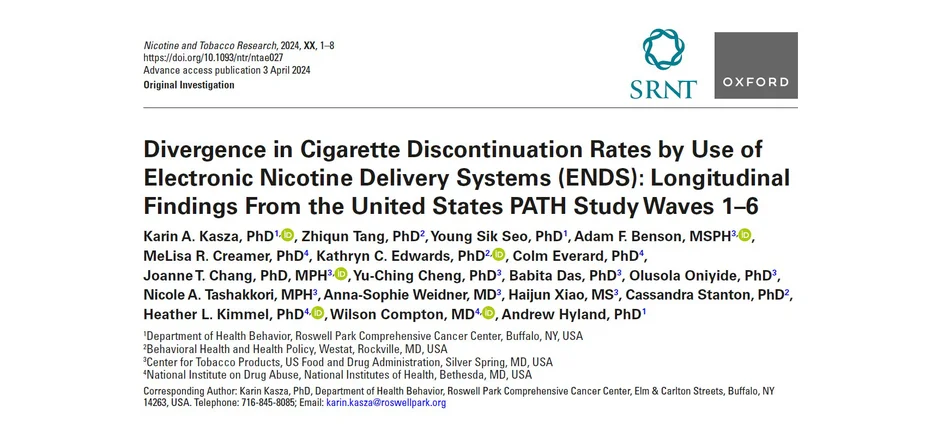
Commentary on the study titled: Divergence in Cigarette Discontinuation Rates by Use of Electronic Nicotine Delivery Systems (ENDS): Longitudinal Findings From the United States PATH Study Waves 1-6 by Karin A. Kasza and colleagues. Nicotine and Tobacco Research, 2024, XX, 1-8; https://doi.org/10.1093/ntr/ntae027; published April 3, 2024.
The principal investigator of the presented study emphasizes the importance of using the most recent data when making public health decisions. Policies, especially health policies, should be based not only on the most recent, but also on reliable research results in accordance with EBM (Evidence-Based Medicine) principles. Undoubtedly, this is very important, especially since the entire European Union bases its policies on scientific evidence, as explicitly enshrined in the Maastricht Treaty.
In the U.S., an observational study was conducted on a large population of adultcigarette smokers, with the endpoint being the percentage of people who abstained from smoking for 30days ("cigarette discontinuation" defined as if they smoked cigarettes in the past 30 days and whether they used electronic nicotine delivery systems in the past 30 days). Adults who smoked regular cigarettes and used e-cigarettes at the same time were compared with those who smoked regular cigarettes and did not use e-cigarettes. Two periods were studied: one was 2013-2016 and the other was 2018-2021. The percentage of those who attempted a minimum 30-day abstinence from smoking was 15.5 percent for those who used e-cigarettes and the same 15.6 percent for those who did not use e-cigarettes.
However, the percentage of those who quit smoking changed in the following years. In the second period, only 20 percent of smokers who did not use e-cigarettes stopped smoking regular cigarettes, and of those who used e-cigarettes, 30.9 percent stopped smoking regular cigarettes. What changed? What factors played a role, and will this difference continue in the future?
The study under discussion is not an experimental study, which would be unethical to conduct. The results of the observational study under discussion make one wonder about the reasons for the differences. Researchers wonder about the impact of the increase in sales of e-cigarettes in the market, changes in e-cigarette technology, the impact of new regulations, as well as the COVID-19 pandemic. Perhaps all of these factors mattered? Or maybe the world is changing? Maybe more and more people are aware of the harms of smoking? Since smoking is becoming "passé," maybe more and more people want to quit and those aware of the choice are simply turning to e-cigarettes more often? For those "choice-conscious," e-cigarettes provide the satisfaction of taking nicotine, but do not poison them with the many dangerous substances of tobacco smoke. The unaware continue to poison themselves with burnt tobacco.
It is noteworthy that the percentages of those who make attempts to stop smoking are increasing in both compared groups. The conclusion is that thanks to the presence of e-cigarettes on the market, more smokers of regular cigarettes are making attempts to free themselves from compulsive tobacco smoking.
Author: Krzysztof Łanda
The original study in PDF: here
Topics
nikotynizm