A conversation with Professor Dariusz Jurkiewicz, head of the Department of Otolaryngology and Laryngological Oncology with the Clinical Department of Cranio-Maxillofacial Surgery at the Military Medical Institute in Warsaw.
Chronic sinusitis with nasal polyps progresses slowly. Symptoms are often downplayed

Published June 22, 2023 10:00
If we're talking about chronic sinusitis with nasal polyps, we're talking about a disease that, on the one hand, is a serious illness, and on the other, one that is also very often underestimated. Why is this the case?
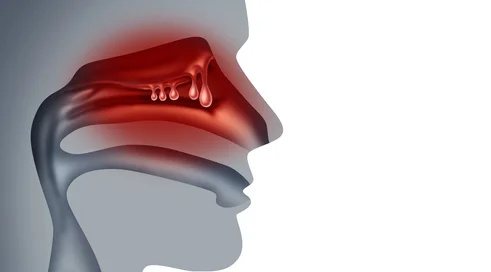
Chronic sinusitis with nasal polyps is a chronic inflammatory process affecting the nasal mucosa and paranasal sinuses. Symptoms build up slowly and initially the patient has virtually no complaints. Because of this, he does not rush to see a doctor or seek help for his symptoms. He only comes forward when these symptoms are very severe, i.e. the patient cannot breathe through his nose, has nasal leaks, complains of facial pain or has olfactory disturbances. Then his life, both personal and at work, is severely affected, and this is the reason why the patient reports to the doctor.
And once the patient has approached the doctor, what is the doctor able to offer him? What is the pattern of treatment?
The patient, first of all, needs to be thoroughly questioned about the symptoms: What are the symptoms? Since when do they occur? Are they related to the seasons? We need to determine whether it is sinusitis, whether there are any anatomical deformities in the nose, whether they are allergic rhinitis. These symptoms are all very similar and the history is of colossal importance to guide us into a certain diagnostic path. Another essential examination is the examination of the nasal cavities, which is the typical rhinoscopic examination, but at the moment the preferred examination is the endoscopic examination of the nasal cavities, which can show us exactly what is going on within the nasal and sinus mouths. With it, we can determine whether there are nasal deformities, small polyp lesions or lesions of a different nature that can cause such symptoms. Based on these factors, we can make a preliminary diagnosis. A CT scan of the paranasal sinuses is a decisive test and clears up any doubts, but we do not commonly perform it. Instead, it is always required before surgery. Also, if we use conservative treatment for several months and there is no improvement or there is deterioration, there is a suspicion of complications, such as orbital or meningitis, then we should perform such a CT scan. This set of examinations already gives us the full possibility of making a diagnosis and indicates where these lesions are located, their nature and severity. This allows us to choose the appropriate treatment.
What kind of treatment can it be at this time?
Treatment, of course, begins with conservative treatment. It's mainly not rinsing the nasal cavities, which clears them of secretions or lingering, allergens. The next step is the use of intranasal steroids, which are good at controlling the inflammatory process within the nose and paranasal sinuses. If there is no improvement with long-term drug treatment, there are indications for surgical treatment. It is usually performed using an endoscopic, minimally invasive technique to open the paranasal sinuses into the nasal cavities, remove the lesions that are there and create a good connection between the nose and the sinuses. In Poland, there is also an emerging option for treatment with biologic drugs that affect inflammatory processes in sinusitis. There is a lot of hope that the use of these drugs can result in longer remissions between treatments, or a significant improvement in patients' condition. We are preparing a drug program we are constructing the inclusion criteria. In European countries, these drugs are already practically available for primary treatment. We plan to create a criterion of having undergone at least two operations. The effectiveness of surgical and conservative treatment is low, hence the recommendation of biological treatment, but surgical treatment is an important element insofar as it makes it possible to correct certain anatomical changes, such as curvature of the septum, or changes in the area of the sinus mouth. This treatment results in a fusion of the nasal cavities with the sinus cavities, which will facilitate the administration of drugs intranasally. This is a costly treatment and the criteria, at least at the initial stage, allows to select such a group of patients who need it most.
Are there any recommendations or positions that have been shown a path for implementing this treatment?
In Western countries, it is a matter of reimbursement. If this drug is reimbursed without any restrictions, it can be used as a first-line treatment. In many countries, on the other hand, it is determined by restrictions, allowing us to select the group of patients most in need. If we start treatment with biologics, when we have on a whole arsenal of other drugs, we use a higher-generation treatment often in patients with simple nasal polyps, for example. In such a situation, it seems that gradation is the most appropriate treatment at the moment.
On the part of patients, on the other hand, the wisest course of action is to contact a doctor quickly. When the course of the disease becomes more severe, it results in costs and for personal life and social or systemic costs, for example, due to frequent sick leave.
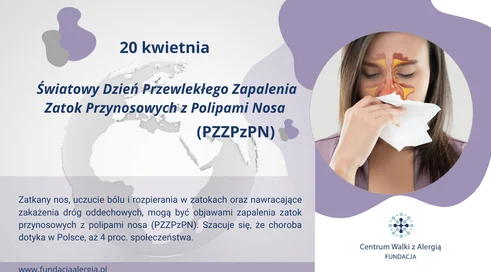
Chronic sinusitis with nasal polyps is a problem that affects about 4 percent of the population. However, if we look at the data obtained at autopsy, it turns out that about 30-40 percent of patients have nasal polyps with which they never reported to a doctor. Bronchial asthma is a similar disease, and a patient who suffers from it reports to the doctor sooner because they have a lot of shortness of breath, the symptoms are more dramatic. Nasal polyps and chronic sinusitis progress slowly, even with full nasal blockage, after all, the patient can breathe through his mouth. There are no dramatic symptoms that threaten his immediate functioning or life, but those that are, cause the patient to function less well, get less sleep, be drowsy during the day, and work or study less well. These are minor ailments that consequently give rise to major problems, both socially and professionally.