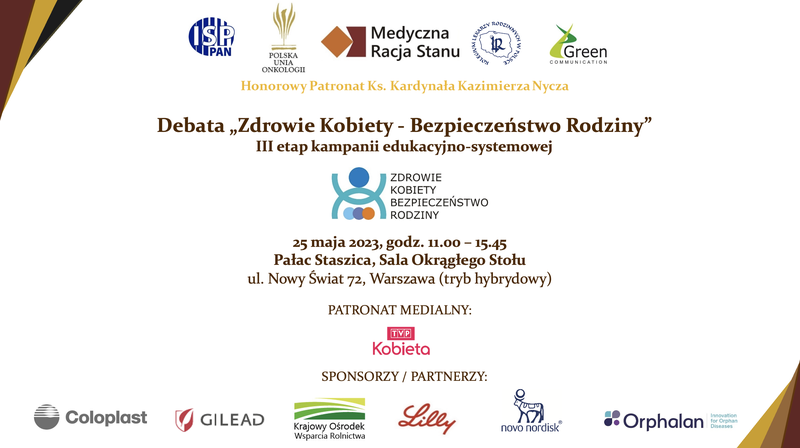
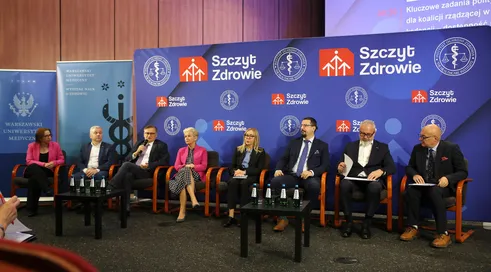
Women's health determines the health well-being, including mental well-being, of their children and families. Therefore, it requires special attention in the state's health and social policies, experts of the Medical Ration of State stressed at a meeting held on May 25.
Medical Rationale for Women's Health

Published May 31, 2023 08:00
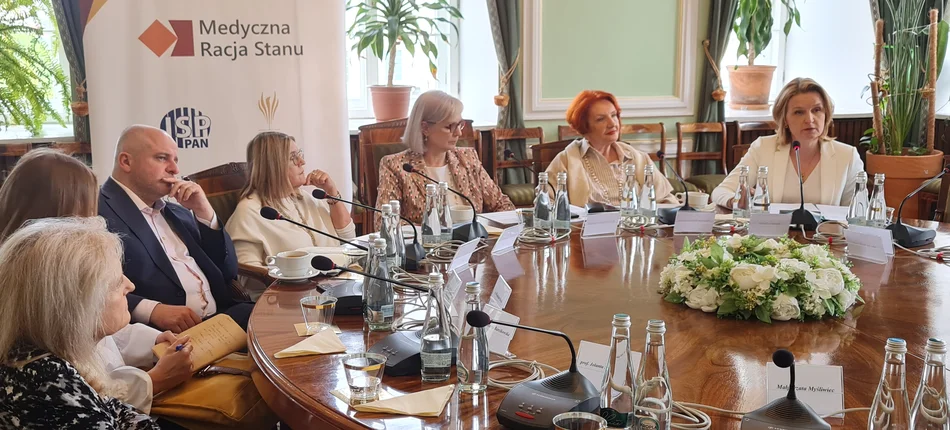
Ewa Falkowska, Director of Advocacy at UNICEF POLAND, stressed that all UNICEF programs directed at children take into account the health of their mothers. She pointed out the correlation between a woman's health and the health of her offspring.
Barbara Socha, Undersecretary of State at the Ministry of Family and Social Policy, pointed out the new threats to children's mental health posed by social media. - The term digital maturity or addiction to excessive screen time has already appeared. Since 2013 when social media became available on smartphones, the number of youth mental problems, including suicide, has increased. That's why we want to introduce solutions to combine women's work with raising children, so they can better control how they spend their leisure time," she informed. She pointed out that Polish women, unlike other European women, rarely work part-time. Only 5% do so. Meanwhile, in Germany 50% of ladies choose this form of employment, and in the Netherlands 60%. - We will seek the consent and serious treatment of women who want to provide their children with preventive mental health care and have more time to raise them, she announced.
Seniors - Health and Care Challenges
Prof. Ewa Marcinowska-Suchowierska of the Presidential Health Council reminded that we live in an aging society. - Due to multi-disease and multi-medication, seniors are "fragmented" into different specialties, and there is a lack of an outlook that ties this together. We have only 530 geriatricians, and half of them are inactive in this specialty. Therefore, the Council is working on the introduction of special geriatric care that constitutes a system to support the activities of the primary care physician," she announced.
Attorney Piotr Mierzejewski of the Ombudsman's office said that in 2050 the population of eighty-year-olds will make up 10% of the population. - This is therefore the last moment to prepare the health care system for this challenge, he said. Piotr Mierzejewski also drew attention to staffing problems. In Poland, there are 1.35 geriatricians per 100,000 people, while in Sweden there are 7.7. He also recalled that during the formation of the hospital network, the Ombudsman called for the inclusion of geriatrics in the network, but this demand was not met.
Prof. Maria Barcikowska from the Department of Neurology at PIM MSWiA spoke about neurodegenerative diseases. She pointed out that Alzheimer's disease affects single women more often, since they live longer. Women are also most often the caregivers of patients with the condition. Dr. Agnieszka Jankowska-Zduńczyk, president of the College of Family Physicians in Poland, spoke about the health condition of active women from the perspective of a family physician. She pointed out the need for respite care for mothers of sick children.
Prof. Artur Mamcarz, head of the Third Department of Internal Medicine and Cardiology at WUM, spoke about the importance of lifestyle medicine for maintaining motor and intellectual performance in advanced age. He drew attention to sleep medicine. Prof. Maria Barcikowska added that, according to recent studies, sleep deficiency is also a risk factor for Alzheimer's disease.
Safety of mother and child - challenges of pregnancy and postpartum time
Dr. Urszula Tataj-Puzyna, research and teaching assistant professor at the CMKP's Department of Obstetrics, and psychologist Dr. Beata Szlendak, who together conduct research on the needs and expectations of women after an unsuccessful prenatal diagnosis, pointed out the shortcomings of such care. Doctors are not sufficiently educated in this area, they have no understanding of these patients, and there is a lack of midwives dedicated to these women.
Dr. Urszula Tataj-Puzyna also spoke about the increasing number of cases of panic fear of pregnancy and childbirth, the so-called tokophobia. In her opinion, this is also one of the reasons for the excessive number of cesarean sections in Poland. She pointed out that there is only talk about postpartum depression, meanwhile, depression often attacks during pregnancy. Hence the huge role of a well-prepared midwife.
Prof. Malgorzata Kolodziejczak, president of the Polish Scientific Society Coloproctology Club, who heads the Warsaw Proctology Center at St. Elizabeth's Hospital, called for reimbursement for services related to perianal damage to anal sphincters. Today, this complex operation is not priced by the National Health Fund. Besides, after the operation, patients require rehabilitation, and there are no centers to provide it. - Anal incontinence is a "silent disease" that is not talked about, she informed. She added that sphincters can be "repaired," but it is a difficult specialized operation that requires years of experience. - Meanwhile, many times patients have an emergent stoma while waiting for scheduled reconstructive surgery, and these are young women, mothers who want to return to social and family activities as soon as possible.
Cezary Pruszko, president of MAHTA, a company that has prepared a pro bono opinion presenting the health and economic value of the solutions prepared by Prof. Kolodziejczak, informed that the cost of the operation is about PLN 10 thousand. Meanwhile, the National Health Service incurs an annual cost of 1.5 thousand zlotys for the care of these patients, mainly for diapers, antidepressants, and protective measures. Indirect costs amount to more than PLN 16 thousand per year. They consist of rehabilitation benefits, the value of lost productivity, disability benefits, unpaid taxes and contributions.
Former Minister of Health Slawomir Gadomski, director of the Central and Eastern Region at Diagnostyka, talked about a novel test for endometriosis. The problem affects 3 million women of reproductive age in Poland, but the figures may be underestimated. In addition, 35 to 50% of infertility cases may be related to the condition. Endometriosis also increases the risk of cancer and cardiovascular disease. Researchers at Warsaw Medical University have developed a minimally invasive test that can provide a diagnosis in a dozen days. The test is registered as a medical device in Poland, and will soon be in the UK as well. This could improve diagnosis, as the average time to diagnosis of endometriosis in Poland is 7 to 10 years.
Prof. Marcin Siwek of the Department of Affective Disorders at the Jagiellonian University Department of Psychiatry presented the challenges of postpartum depression. - Eighty percent of women develop mood deterioration within hours of giving birth, which passes on its own. But 15% develop depression, and these statistics are underestimated. Postpartum depression is diagnosed in only 1/3 of cases, and only 6-7% of women get adequate help, he calculated. He stressed that the disease also affects the child's development.
Diseases of civilization - prevention: healthy habits, healthy food
Prof. Leszek Czupryniak, head of the Department of Diabetology and Internal Medicine at WUM, reminded that for patients with type 1 diabetes, a continuous sugar monitoring system, including the most popular FreeStyleLibre, has been reimbursed since January 1 this year, which completely changes the control of this disease. - We are seeking reimbursement of this system for all pregnant women with gestational diabetes, not only those treated with insulin," he informed. He also spoke about new effective drugs for obesity. - If we don't spend the funds to treat obesity, we will pay to treat diabetes, heart disease and other diseases whose mother is obesity, he stressed.
Marcin Wroński, deputy director general of the National Agriculture Support Center, spoke about efforts to change the eating habits of Polish children. He talked about a program for schools to provide fresh dairy portions and fruits and vegetables. - We teach healthy eating through play. The program is bearing fruit, as participants are reaching for fruits and vegetables and dairy products more often.
Experts also discussed the problems of patients with spina bifida. Those under 18 have access to free hydrophilic catheters. Dr. Leszek Borkowski pointed out that young people between the ages of 18 and 26 have to cover part of their costs. - This is a time when the wealth of young people with disabilities is poor. Most often, they cannot find a job. Therefore, this group should also gain the right to free hydrophilic catheters," he urged. The use of uncoated catheters (dry) is associated with suffering, discomfort, injury and urethral infections. - To deny the use of a modern painless, injury-free and infection-free catheter is to condemn people to unimaginable pain and suffering. That is why we are calling for funding of this equipment without age restrictions," concluded Prof. Zbigniew Zuber, head of KAAF's Department of Pediatrics and chairman of the Expert Council on Rare Diseases of the Medical Ration.
Prof. Barbara Radecka, head of the Department of Oncology at the Prof. Tadeusz Koszarowski Oncology Center in Opole and the University of Opole, spoke about access to effective therapies in breast cancer. Thanks to a decision by the Minister of Health, as of November 1, 2022, sacituzumab Govitecan is reimbursed under the drug program for the indication of second- or third-line metastatic triple-negative breast cancer for patients who have previously received at least two lines of systemic treatment. The expert pointed out that doctors and patients are currently waiting for abemaciclib to be reimbursed for patients with early hormone-dependent breast cancer at high risk of recurrence, which affects 30 percent of patients. Often these are younger women and the risk of recurrence even 10 years from now puts them at risk. - In such cases, more aggressive treatment should be used. Adding a drug that inhibits the division of cancer cells reduces the risk of invasive recurrence, which shortens patients' lives, she pointed out. The drug is known because it is reimbursed in advanced disease.
Autoimmune diseases more dangerous for women
Prof. Brigid Kwiatkowska, national consultant in rheumatology, reminded that autoimmune diseases affect women several times more often, who respond less well to treatment.
She informed that two JAK inhibitors are available for atopic dermatitis in Poland. She stressed that treatment of this disease is extremely important. - If someone has psoriatic arthritis, inflammatory bowel disease and atopic dermatitis, by using one upadacitinib molecule they can get improvement in all of these conditions, she pointed out.
Prof. Konrad Rejdak, president of the Polish Neurological Society, reported that twice as many women as men are affected by the projection-remission form of MS. And the disease affects young people.
Rare diseases - a problem for 3 million families
MP Barbara Dziuk, chairwoman of the Parliamentary Group on Rare Diseases, spoke about the main challenges in the field of rare diseases. She noted the importance of genetic diagnostics.
Prof. Zbigniew Zuber reminded that there is a drug program for the treatment of Wilson's disease, but few doctors know that it is available. Wilson's disease is fatal and leads to premature death if not treated effectively. Katarzyna Lisowska of the Per Humanus Foundation pointed out that only three young patients were included in the program. Meanwhile, the number of people with Wilson's disease is estimated at around 1,000 in Poland.
Prof. Zbigniew Żuber lamented that archaic and poorly effective treatments are used in Poland, which cause many side effects, adversely affecting patients. Often treatment is started with zinc, which reduces the absorption of copper from the intestines, but does not help remove excess copper from the body. This is different from global and European trends and guidelines, according to which the chelating drugs trientine or d-penicillamine are administered first. - In Poland, trientine is also too rarely used when d-penicillamine proves ineffective and poorly tolerated. And the longer a patient is ineffectively treated, the more difficult it is to achieve improvement in the patient's condition later, he pointed out. Therefore, there is a need to implement a diagnostic and therapeutic pathway for patients with Wilson's disease. This will allow faster diagnosis and implementation of the optimal treatment for each patient.
Prof. Jolanta Sykut-Cegielska, national consultant in metabolic pediatrics, spoke about phenylketonuria in pregnant women. It is the most common inborn metabolic disease. Lack of treatment results in mental retardation and stunting of normal development. In the case of maternal phenylketonuria, damage to the fetus already occurs in the prenatal period. Poland was one of the first countries to introduce screening for this condition. However, there are still women who were born after the introduction of screening and may themselves give birth to a sick child. Unfortunately, there is a lack of knowledge among gynecologists-obstetricians on this subject. - We are the last country in Europe not to reimburse tetrahydrobiopterin (BH4), which would reduce the risk of fetal damage in pregnant women, she pointed out.