When we make love, in addition to feelings, we also exchange bacteria and viruses. This is not romantic information, but knowledge on this subject will help us enjoy sex with even more enthusiasm. How to take care of the intimate sphere - we ask Dr. Grzegorz Południewski, a specialist in obstetrics and gynecology from the Gameta Health Center in Warsaw.
How dangerous is sex?

Published March 31, 2023 12:16
Agnieszka Fedorczyk: Do STDs and sexually transmitted diseases mean the same thing?
Dr. Grzegorz Południewski: The name "venereal diseases" is now obsolete. It has disappeared from the medical vocabulary as too narrow. Years ago, this term referred to just a few diseases, including syphilis, gonorrhea and some protozoan infections, such as vaginal cilia. And these diseases, yes, still exist, but they are no longer as serious a problem as they once were, because today we can treat them effectively and quickly with antibiotics. Currently, diseases that can spread sexually include about 60 conditions.
How did such a plethora of intimate diseases emerge?
Today we know that diseases related to the intimate sphere have many more routes of transmission than classic sexual intercourse. These are largely viral diseases, such as hepatitis B, hepatitis C, vulvar herpes (HSV), HPV, or papillomavirus, HIV and many others. Add to this set of protozoan and bacterial diseases, less common or more difficult to diagnose. They do not always cause acute and characteristic symptoms, and are often chronic. Those who succumb to infection do not know for a long time that they are sick, and infect others. Today we travel a lot and to different parts of the world, eagerly to the Mediterranean countries - Italy, Turkey, Greece, Morocco, Egypt, and there some of these diseases have their own characteristics. Not to mention trips to such remote areas of the world as India, Thailand or Haiti, where sexually transmitted diseases are different.
We have stopped talking about intimate diseases in recent years. Why?
Because this problem has seemingly diminished. Among other things, this is because many of these diseases manage to be effectively treated by fairly simple means. Syphilis, or syphilis, is not a problem these days, because we have effective antibiotics for it. More than one person who has gone to the doctor because of a bronchial or pulmonary infection has been cured of gonorrhea, by the way, with a higher-spectrum antibiotic. Such a person may not even have known he was sick. The bacteria that cause syphilis or gonorrhea still exist and infections still occur, but cases of neglected, advanced syphilis with neurological complications are rare today. The problem of modern medicine is diseases that are resistant to available antibiotics, as is the case with gonorrhea.
How is it possible for a person to have syphilis or another sexual disease and not know it...?
People downplay the problem - they don't go to the doctor with early symptoms. And as a result, they infect others...
What should concern us?
Any lesions on the genitals, pimples, warts, purulent blisters, itching, burning, discharge, enlargement of the axillary or femoral lymph nodes, skin rash. With such symptoms, you should immediately see a doctor. It's also a good idea, especially during the summer, to use your brain and get some reflection. Vacations are conducive to making friends, including sexual ones. Let's remember to look not only deep into the eyes of a newly met blonde or blonde woman, but also at the skin - whether there are lesions in the perineal area that can be seen with the naked eye. Condyloma or vulvar herpes (affecting the genitals of both sexes) is extremely easily contagious. If someone decides to have risky sex, i.e. with a new acquaintance and, in addition, without a condom, he or she is playing with fire.
Does a condom protect 100 percent against sexually transmitted infections?
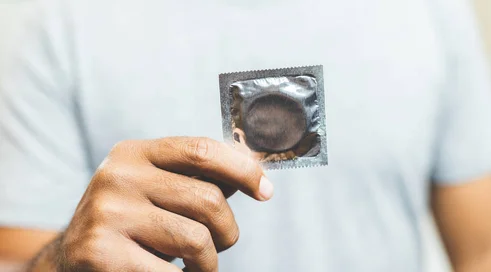
Without a doubt, it should be used because it reduces the risk of infection, such as HIV or gonorrhea. But it does not protect 100 percent against all diseases, such as vulvar herpes.
Why?
A condom only protects against diseases that are transmitted through contact with secretions from the penis or vagina, or after ejaculation. And many viruses are present on the skin outside the condom-covered area.
How does the infection occur? Does the skin have to be damaged?
Let's be clear: if we are sexually active, there are always micro injuries, even invisible to the eye. Abrasions, ruptured epithelium - this is a normal occurrence, and by the way open gates for microorganisms, which facilitates infection. Skin without damage is also not an insurmountable barrier to most microorganisms. In addition, the vulvar herpes virus, for example, already remains a lifelong souvenir. After an acute period of symptoms, the infection goes into a latent form, only to make itself known again in the form of ailments and eruptions when immunity declines.
Women are more vulnerable to sexually transmitted infections?
All conditions affect both men and women. Due to the structure, some of them give less discomfort in men or women, but the differences are small. In the case of HIV infection, the risk of transmission of the virus from a woman to a man is somewhat lower, because the main source of infection is the leukocytes present in sperm, which as immune cells pick up viruses.
The fact that the female organs are hidden inside and the male organs are outside makes a difference?
Yes, but this applies only to certain diseases, such as fungal infections. The skin on the penis is dry, and in the vagina is moist, warm, fungi love such an environment and multiply perfectly in it. Fungal infections are not considered sexually transmitted diseases strictly speaking, but cohabitation between a healthy person and an infected one is the way they spread.
What doctor should I report to if I notice alarming symptoms?
The treatment paths are established. Women in the case of inflammation, burning, itching, discharge - because these are the most common symptoms of intimate infections - should go to a gynecologist, who is a general practitioner for ladies and a referral is unnecessary. The patient is immediately diagnosed and treated accordingly. Men, on the other hand, should go to a urologist or dermatologist. Advanced forms of syphilis, gonorrhea or AIDS should be treated in dermato-venereal or infectious disease hospitals.
What about prevention?
The basis is reasonableness in making decisions about intercourse - with whom and when to go to bed. The rather liberal approach to sex these days should force us to be as rational as possible with our health. It is important to have regular preventive examinations and seek treatment as soon as possible when we have symptoms of disease. In general, every sexually active person should do such examinations at least once a year. Preferably after the vacations, i.e. about three months later, because that is how long the serological window lasts, i.e. the time it takes for the body's immune response to detect the disease in the blood.
What increases the risk of infection?
Undoubtedly, lack of sanity, lifestyle, sexual freedom. The more partners, the greater the risk of transmission. It is worth knowing that there are extra-sexual ways of infection, such as vulvar herpes, HPV or cilia. Not so much through the toilet seat, but through shared towels, bedding, borrowed "clothes." Lovers of tattoos should remember to get them done at verified places, get blood tests for hepatitis B and C and HIV. Sexual practices used can cause infection with vaginal cilia of the throat or tonsils, or the occurrence of vulvar herpes in the mouth.
Well... Do oral and anal sex carry a higher risk of infection?
In theory, with oral sex there is less risk of infection because enzymes and antibodies that destroy viruses and bacteria are present in saliva. But the risk is still there. As for anal sex, it is worth knowing that during anal sex virtually all barriers that protect the body from infection are broken. Through anal sex it is many times easier to get infected. In the vagina, mucus or natural bacterial flora that reduce the risk of infection. The presence of bacteria and virus-filled leukocytes within such a blood-rich place as the anal area is a very effective way of infection.
Are there social groups more vulnerable to infection? Adolescents? Adults? Business people?
Everyone is at risk, regardless of age or profession. Risk is determined by engaging in risky behavior. I will cite survey statistics from a few years ago. We asked high school students if they would have intercourse with a new partner without protection because, for example, they hadn't just bought condoms? And imagine that 60 percent of these young people answered that they would not. And it was not only about the risk of pregnancy, but also about infections. In contrast, among forty-somethings, as many as 71 percent answered that they would choose to have such risky sex.
Really? What is the source of this?
For a simple reason. The older we get, the less aware we are of the risks that still affect us. People think that if they live so many years and nothing has happened to them so far, it won't happen to them either. And this is not true. The risk factors at every age are the same. These types of risks are not going away.
How do you assess the sexual awareness of Poles in the context of infections?
Wrong: It is painful that real sex education is being abandoned in Poland. And ignorance results in health and life risks. If we do not teach young people to be assertive in the sexual sphere, we put them at risk of serious diseases. In my opinion, as adults we share responsibility for this. It is indirectly through our fault that situations arise when a girl or boy is ashamed to propose or even force a partner to use a condom.
Who should impart knowledge about sex and when?
Sex education should be part of school education, because it is a sphere of hygiene in the broadest sense. In my opinion, the fact that you wash your hands after leaving the toilet is as important and obvious as the fact that you put on a condom when having intercourse with a new partner. At least that much. These are areas of hygiene that should be passed on to every student. And the fact that this is not being done is the fault of politicians. We are in the 21st century, and this basic education is not there. In the West, sexual awareness is at a much higher level. As an example, let's take a very useful custom, according to which a newlywed couple, who before deciding to have unprotected sex, first politely goes to the doctor and takes basic tests - for HIV, for WR, a vaginal swab. He repeats them after a few weeks and if it's okay, they make love without a condom. In our country, such awareness and such practice are marginal. Yes, such sensible couples also appear in my office, but it is not common in Poland. And after all, what is important is not only the tender gaze of a blond or blonde, but the story they carry with them. Because in sex, in addition to feelings, we also exchange viruses and bacteria.